




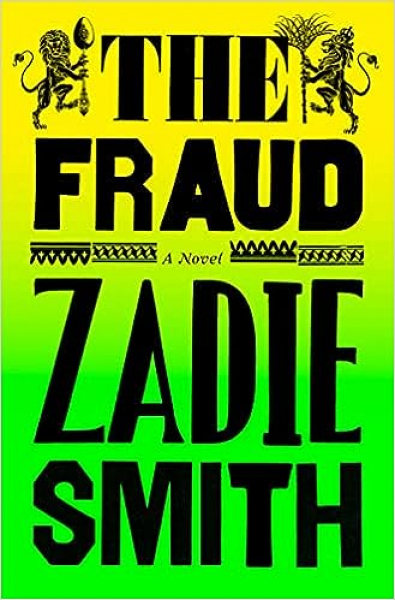
"The Fraud" by Zadie Smith
From acclaimed and bestselling novelist Zadie Smith, a kaleidoscopic work of historical fiction set against the legal trial that divided Victorian England, about who gets to tell their story—and who gets to be believed
It is 1873. Mrs. Eliza Touchet is the Scottish housekeeper—and cousin by marriage—of a once-famous novelist, now in decline, William Ainsworth, with whom she has lived for thirty years.
Mrs. Touchet is a woman of many interests: literature, justice, abolitionism, class, her cousin, his wives, this life and the next. But she is also sceptical. She suspects her cousin of having no talent; his successful friend, Mr. Charles Dickens, of being a bully and a moralist; and England of being a land of facades, in which nothing is quite what it seems.
Andrew Bogle, meanwhile, grew up enslaved on the Hope Plantation, Jamaica. He knows every lump of sugar comes at a human cost. That the rich deceive the poor. And that people are more easily manipulated than they realize. When Bogle finds himself in London, star witness in a celebrated case of imposture, he knows his future depends on telling the right story.
The “Tichborne Trial”—wherein a lower-class butcher from Australia claimed he was in fact the rightful heir of a sizable estate and title—captivates Mrs. Touchet and all of England. Is Sir Roger Tichborne really who he says he is? Or is he a fraud? Mrs. Touchet is a woman of the world. Mr. Bogle is no fool. But in a world of hypocrisy and self-deception, deciding what is real proves a complicated task. . . .
Based on real historical events, The Fraud is a dazzling novel about truth and fiction, Jamaica and Britain, fraudulence and authenticity and the mystery of “other people.”
Author
Zadie Smith is the author of the novels White Teeth, The Autograph Man, On Beauty, NW and Swing Time; as well as a novella, The Embassy of Cambodia; three collections of essays, Changing My Mind, Feel Free and Intimations; a collection of short stories, Grand Union; and the play, The Wife of Willesden, adapted from Chaucer. She is also the editor of The Book of Other People. Zadie Smith was born in north-west London, where she still lives.
Praise
“[The Fraud] offers a vast, acute panoply of London and the English countryside, and successfully locates the social controversies of an era in a handful of characters. . . . In all of her books Smith has paid attention to a mixed-up London and particularly to Willesden, where she grew up. In this novel, she is quite actively digging into London’s history, trying to understand how a person like her, with European and Jamaican ancestry, came to exist here in the first place. What forces deposited Black people on these shores? With her multicultural eye she also gives us a London that is more racially mixed than that found in other novels about the period. . . . As always, it is a pleasure to be in Zadie Smith’s mind, which, as time goes on, is becoming contiguous with London itself. Dickens may be dead, but Smith, thankfully, is alive.” —Karan Mahajan, The New York Times Book Review
“The Fraud, [Smith’s] sixth novel, is partly about an enslaved man on a Jamaican sugar plantation, and it’s a comedy: those two things at once. Few would dare; fewer could pull it off as Smith does here, mixing narrative delight with a vein of rapid, skimming satire as she sketches scenes of life in 19th-century England and the Caribbean . . . In all this multiplicity, different models of Victorian fiction are inherited and transformed . . . The Fraud is a curious combination of gloriously light, deft writing and strenuous construction . . . It slows and expands lavishly in honour of its Victorian subjects, yet its chapters are elliptical half-scenes chosen with modernist economy. Happily its eight ‘volumes’ can be bound with one spine. Here is historical fiction with all the day-lit attentiveness that Eliza hopes for: ‘stories of human beings, struggling, suffering, deluding others and themselves, being cruel to each other and kind. Usually both.’ Generous and undogmatic as ever, Smith makes room for ‘both’.” —Alexandra Harris, The Guardian
