



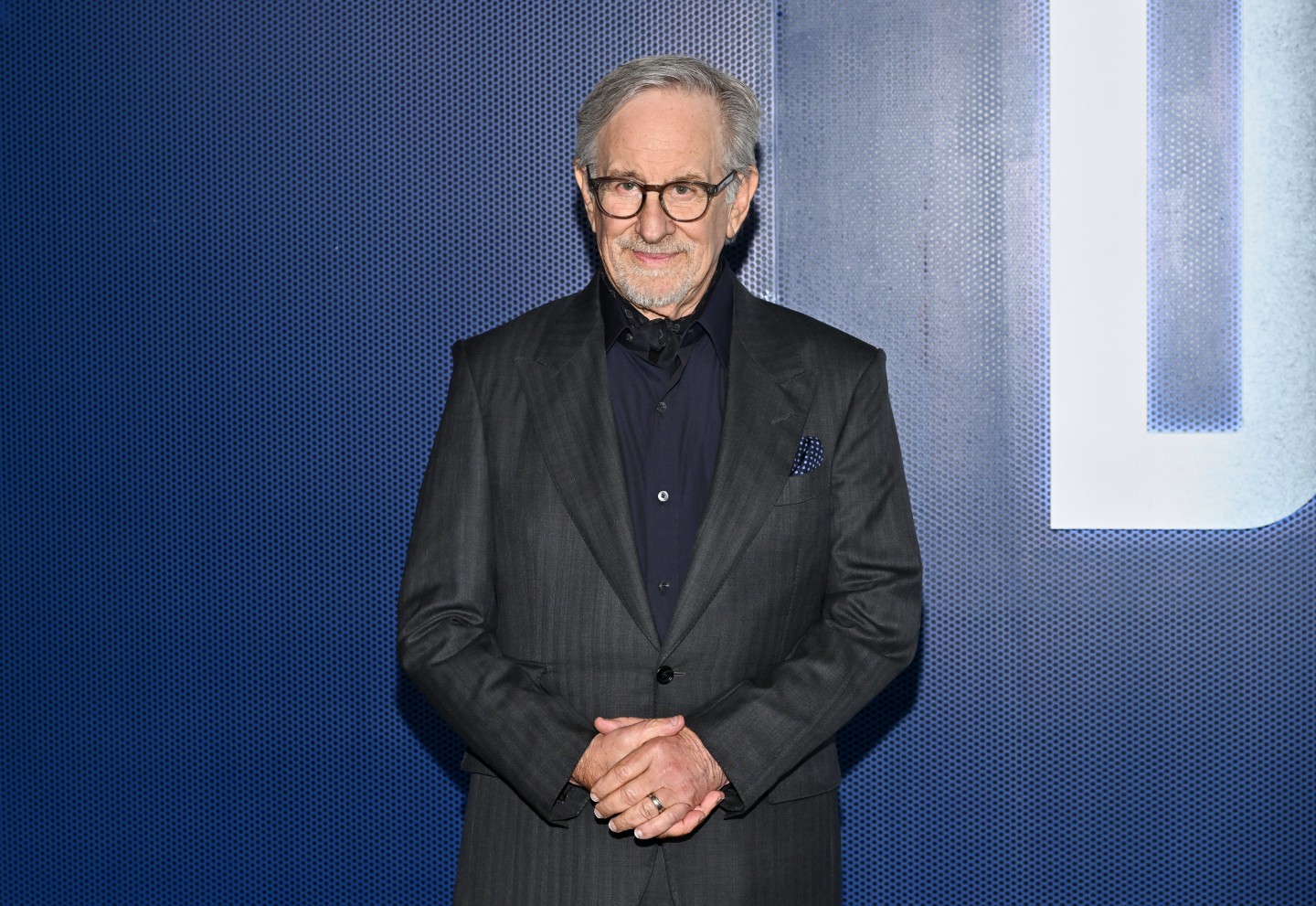
Why Did Steven Get So Dark
*This review contains spoilers*
“We’re all in the gutter, but some of us are looking at the stars.”
That’s one of my favorite Oscar Wilde quotes, from Lady Windermere’s Fan.
The playwright was being his usual playful/metaphorical self. But if you get a tad more literal, you could change “some” to “most,” because who among us, from early childhood onward, at one time or another, did not indeed look up at the starry firmament and wonder what was there?
That conundrum has been with us from time immemorial. The ancients dreaded what was above them, the realm of the gods that controlled their lives.
Not all, however. In the 5th-4th centuries BC, the Greek Atomists, Democritus and Epicurus, speculated about other possibly inhabited orbs in a distinctly modern manner. They reasoned that the universe is infinite and therefore there must be innumerable worlds, many of which could contain life.
In our time, easily the best-known proponent of extra-terrestrial life, at least cinematically but arguably from any perspective, is renowned filmmaker Steven Spielberg. Two of his many great hits or blockbusters (a term coined by the groundbreaking success of his Jaws) are Close Encounters of the Third Kind (1977) and E. T. the Extra-Terrestrial (1982), both about the arrival on our planet of benign beings from outer space.
Not only are they benign in both films, but they are also, although there is no scientific basis for this, largely anthropomorphic, with their human-like shapes differing mostly in size. This enhances the tone of the two films, making them gentle, reassuring, and finally inspiring.
At the end of Close Encounters, we are thrilled, our hearts pounding, as Richard Dreyfuss walks onto the spaceship for what promises to be an amazing adventure, even though we have expected this finale all along. In E.T., the beguiling and cute space alien is deathly sick but revives from the love of a human boy. The kids rescue him on flying bicycles and take him to a mothership that flies him home. Again, we are thrilled.
Is any of this real? It doesn’t try to be, nor should it. We are in a fairytale universe where the irrational is acceptable, even by adults.
After all, no one actually knows what is out there, and what people claim is more projection than anything else.
Notably, physicists tell us our known universe is expanding faster than the speed of light. That means stars are being born that we will never see because they will expand faster than their light can reach us. This is hard to wrap one’s mind around and only adds to the perception that the way we conceive of extra-terrestrials is, perforce, projection. We may never see any of these beings, if they exist.
Which brings us to Spielberg’s most recent outing—Disclosure Day—that marks a return to the extra-terrestrial subject after decades and has been hyped as a revival of the Spielberg of old.
It is not.
But before I get into details, let me say that I enjoyed the movie; at least I didn’t feel compelled to leave, as I do with so many these days. Mediocre Spielberg is better than almost everything else out there.
Nevertheless, the film is a hodge-podge, too much of it taken up by endless chase scenes that seem phoned in—not in the E. T. phoning home sense, but in the sense of scenes saved in the cutting room. (When two good guys are about to be poleaxed by fifty bad guys, cut away at the last second in the hopes the audience won’t question how they got out of it.)
Behind this unconvincing high jinks is arch-villain Noah Scanlon, CEO of the supposedly nefarious government-allied Wardex Corporation, played by Colin Firth, one of the most respected actors in the English-speaking world. Here, he is called upon to play a role that is mostly hokum. He directs minions in pursuit of a “device” (yes, it’s called that) that is never really fully explained, has something to do with secret alien technology, but can do just about anything when you need it. Scanlon himself possesses one of these.
What rescues this cinematic claptrap is almost entirely due to the superb performance of Emily Blunt as Margaret Fairchild, a television meteorologist. In the past, her character has been taken over by you-can-guess-what, leaving her able to do things like speak fluent Korean without studying a word of it. More importantly to the story, she has the uncanny ability to immediately see the most intimate particulars of people’s lives and personalities without knowing or even having met them at all. Ms. Blunt makes this all believable.
Her performance echoes the romantic mystery of the original Spielberg films. Unfortunately, there is not enough of it.
Screenwriter David Koepp, who did a better job for the director in the adaptation of Michael Crichton’s Jurassic Park, has called Disclosure a “UFO thriller,” and I suppose it is. But that means it must be judged on those terms. The final revelation must come to something. Here it is, at best, wildly improbable, and worse, in its message, outright disconcerting, even dark. It is also completely unearned.
Leading up to this final reveal, we are confronted with the old, discredited, melodramatic Roswell, New Mexico stories of injured or dead extraterrestrials (by humans?) as if they were true, as well as the canard that our people were busy ripping off their advanced technology.
The Roswell incident occurred in 1947, and since then, there have been no authenticated alien bodies, no authenticated alien tissue, no authenticated unexplained technology of any sort, nothing of substance other than rumors that are often contradictory.
Spielberg is expecting us to swallow this as a cover-up that has been going on now for nearly 80 years through fifteen presidential administrations, plus thousands of military personnel, scientists, intelligence officers, and so forth.
Yes, governments, all governments, have secrets, many quite shocking, recent and reprehensible, but considering the implications in this case, this is a bit much. On top of that, the recent releases by President Trump, who is more transparent than his predecessors on this subject, revealed no substantive evidence beyond the usual blurry photos that seem to fascinate conspiracy addicts. (If anything explains the secrecy, it is the more realistic concern that these images might be new, advanced weaponry from China or Russia.)
This makes Disclosure's finale all the more laughable. An actual living alien—again, anthropomorphic but larger — is trotted out in what appears to be a plastic container. This is not an E. T. fairy tale. It is supposed to be real—the hidden incarceration of a space alien from a bazillion miles away. We are meant to be astonished and appalled by this mistreatment of an innocent extra-terrestrial, but instead we wonder where he was all these years, how he survived, and who knew about it. The whole thing is impossible and ludicrous, and any seriousness the movie pretended to have collapses. (I apologize for revealing the ending, but it is so shoddy that it is hard to discuss the film without doing so.)
Now this is obviously just my view, and others feel differently. At the moment, on Rotten Tomatoes, 605 of 805 professional reviews are good or “fresh.” Audience reviews are also largely good. (Opening weekend box office, however, indicates it might not earn back its investment.)
As a novelist and screenwriter, I have been reviewed many times and feel uncomfortable acting in that capacity, as I have here, and pretending my view is so important. Reviews tend to bias audiences and readers before they have the opportunity to judge for themselves. I don’t like reviewing because of this, and although I did it often years ago, I have long since ceased. But in this case, there is a broader reason than a personal aesthetic opinion about a film or a novel. What Disclosure reflects is the disturbing zeitgeist of our times, including the arts' increasing irrelevance.
How and why did Steven Spielberg go from a man who wished to uplift the world to someone who sees humanity as capable of torturing or even killing aliens from distant space, as supposedly happened in Roswell, also literally kidnapping them and keeping them in cages? What does that say about Steven, but about us as well, his audience?
This is a theological question as much as anything, and Spielberg and Koepp acknowledge that. They pepper the film with Catholic rather than Jewish religious references, as might be expected of Spielberg. One of those pursued for the “device” is a former novitiate. The abbess of her monastery (Elizabeth Marvel) explains to her what appears to be the filmmakers’ view: The young woman did not leave the novitiate because of God’s failure but because of man’s.
The imperfection of humanity is hard to dispute, but focusing on it in this manner is a far cry from the worldview of Close Encounters and E. T.
It is closer to the worldview of the director of Schindler’s List, but that was based on the most historically verifiable evil. The evil in Disclosure Day is made up. Not only that—unlike, say, a fictional drug dealer or mafioso—it is made up out of nothing.
So where does this come from? What has happened over the years?
The Spielberg of the late 70s and early 80s was working in an optimistic America that was still relatively postwar. Sometimes accused of being shallow, he turned his attention to the darker moments of recent history with Schindler’s List, Munich, Saving Private Ryan, and an even darker fantasy of an alien invasion, an adaptation of H. G. Wells’s War of the Worlds. The latter contains giant extraterrestrials of a rather distant kind from the benign characters of his earlier films.
By then, we were in a post-9/11 America, and nothing was the same. The journey to Disclosure Day is not all that far. Conspiracies, real or imagined, are the order of the day. No one trusts anyone. Why shouldn’t we be housing extraterrestrials as if they were animals in a zoo? Why not make a movie about it?
The center does not hold, not for Steven Spielberg or for any of us.
But instead of making films battling evil, or worse, non-existent evil, why don't we, for a change, emphasize the positive again in our art, build rather than destroy or ridicule?
Menachem Mendel Schneerson, the Lubavitcher Rebbe, put it this way in his essay “How Do You Fight Evil?”:
“Against Evil, you must march to battle on the clouds. You must trample while never looking down…Fight evil with beauty. Defy darkness with infinite light.”
Good advice, not just for Steven but for Hollywood in general. It’s good box office too.
Roger L. Simon is an Oscar-nominated screenwriter and award-winning novelist. His most recent book is EMET. His Substack is americanrefugees.substack.com.
