




A Fantastically Important Political Novel

Last week, The Washington Free Beacon revealed that the leading candidate for Congress in New Jersey’s 12th district, Adam Hamawy, was a longtime friend and supporter of the so-called “Blind Sheikh.” That’s the Muslim cleric who was behind the 1994 World Trade Center bombing.
It also turns out that Hamawy was present when the Blind Sheikh asked another of his followers to kill Egyptian President Hosni Mubarak. That’s substantiated by FBI records and direct eyewitness testimony. What’s more, by his own admission, Hamawy attended a conference alongside the Sheikh at which speakers called for “conquering the land of the infidels" and engaging in “jihad” attacks here in the United States. Another speaker at that same conference, Dr. Ahmad Nofal, is a holocaust denier who claimed that Jews steal the bodily organs of Palestinians.
None of this caused Hamawy to cease contact with the Blind Sheikh.
The anti-Jewish aspect of Islamism is a small part of the danger that it presents, of course. But the antisemitism should not be minimized. After all, the FBI has reported that 70% of all religious hate crimes in the U.S. are being directed against Jews.
That one of the two major political parties is embracing Hamawy is revealing of the degree to which antisemitic beliefs are increasingly being mainstreamed. That’s also seen in Maine, where Democrats are soon going to be nominating as their U.S. Senate candidate a man who in 2014 expressed his admiration for Hamas. Was this ratifying the beliefs he had already expressed when he asked a tattoo artist to inscribe SS regalia on his chest? We can only wonder.
Roger Simon is one of the few people with Hollywood and entertainment industry ties who shows any great concern with these issues, and that’s displayed in his new novel Emet. Best-known as a Hollywood screenwriter, Simon wrote the screeplays for the Richard Pryor movie, Bustin’ Loose, and the Academy Award-nominee, Enemies: A Love Story.
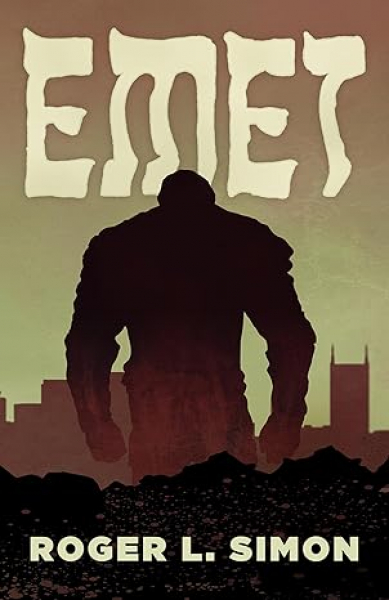
But he is also an unabashed Conservative, Trump supporter and Zionist, and his book expresses those convictions. As such, Emet will be most enjoyed by those who share his outlook. However, it’s also a well-told story of the supernatural in the category of novels like Mary Shelley’s Frankenstein and Bram Stocker’s Dracula.
His hero is a Nashville rabbi named Ben Golub. Ben is unorthodox — in both senses of the word. While the name “Golub” means dove or pigeon, Ben is a bit of a fighter. Yet his violence is carried out by a monster he has created: a golem.
Contemporary readers typically know the Golem as the character adopted by J.R.R. Tolkien for his Lord of the Ring novels. The figure of the golem has much older roots though in Ashkenazic Jewish legends, tales that are very different and upon which Simon bases his story. This takes place in the days leading up to and immediately following the October 7 attacks on Israel.
I don’t want to give away too many of the story’s surprises. But I will say that it has a grand and wonderfully mysterious opening as Golub gradually comes to realize that by setting forth an ancient incantation and prayer that he has literally created a monster.
The story is told in the first person. Simon used this approach for his well-regarded series of Moses Wine mystery novels. (One of these was the basis for the movie The Big Fix with Richard Dreyfuss.) It suits him well as he has a lively voice. It also gives him an opportunity to express his opinion on an assortment of contemporary issues, most especially those connected to wokeness.
Although the tale starts in Nashville, it soon shifts to Cyprus and then Israel, and it has plenty of action with scenes of danger and suspense. The settings are ones Simon is familiar with, and he describes them with great specificity. This assists in making a boldly imaginative story more believable.
The tale also includes several intriguing subplots. One is a love story involving some local Nashville personalities. Simon also depicts the gradual bond that develops between the protagonist and his young grandson, who’s a bit of an intellectual prodigy.
The whole is an intricately-constructed work of fantasy that deals with present-day antisemitism and anti-Zionism. Those concerned with these subjects are in for a fun ride.
Jonathan Leaf is a novelist and playwright and the author of The Primate Myth: Why the Latest Science Leads Us to a New Theory of Human Nature (Post Hill Press).
