




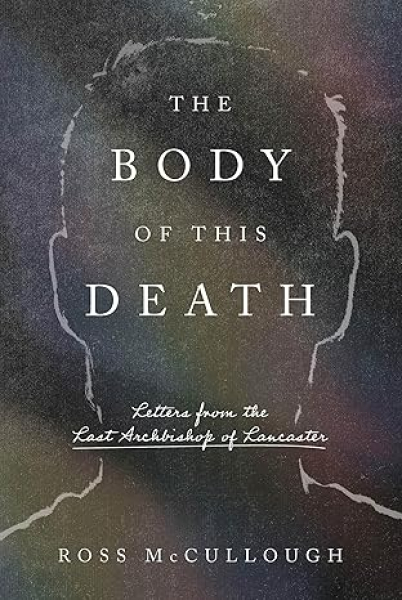
The Body of This Death

Excerpted from The Body of This Death: Letters from the Last Archbishop of Lancaster (Word on Fire Academic)
+++++
Note to the Reader:
I was given this manuscript two years ago by a friend at the diocesan archives of Buenos Aires who knows that I read English. Though it is handwritten, the hand is too fair for it to be anything other than a copy: someone was evidently inspired by the original letters to transcribe them, longhand rather than typed, anonymous rather than signed. Some months earlier, an acquaintance of mine, a fellow biblical scholar, had happened to purchase a translation of the same manuscript at the auction of a bankrupt Spanish bookseller in Copenhagen. This was the first record I could find of a complete edition of these letters, or as complete as we have them here…
Vincent Hermès
Clermont-Ferrand, France, European Union
Year 20 of the New Common Era
My dear Barlow,
Felicity misses her parents terribly, of course. I have paid for not preaching at their funerals, for growing distant, by having to preach in a hundred ways to their daughter. A justice within history.
The afterlife is very matter-of-fact to her. Her parents told her about it; I tell her about it; of course she will see them again. I cannot tell how much she cares about the resurrection specifically. She knows that their bodies are here—we visit their graves—but she hasn’t asked how she can see her parents again if their bodies are in the ground.
So she has a very straightforward hope, I think, and it is not clear to me how it fits alongside her also very real sadness. But perhaps I ask too much: my soul is just as obscure in this regard as hers. My hopes for them, my hopes for her . . . Surely hope is the most temporal of the theological virtues. So much so that it cannot survive the end of time. It looks for what is to come, but it also transforms what has passed. In the medieval madness that maps every triune sign one upon another, hope is the theological virtue that corresponds to memory (faith to intellect; love to will). In faith and love we look to the author of the story, with confidence that he will make things right; in hope we look forward to the act by which he does make it right, the act in the light of which the whole story takes on its coherence as a story, and all things, even dead and gone, are made to serve the Lord. If the past is a foreign country, hope is what makes it a mission field. That does not abolish sadness, but it might perhaps convert it.
Sr. Perpetua,
Let me pray over your proposal. A purer Church can be a temptation—to evil, I mean, not just to good.
I sometimes wonder how many people have nipped into purgatory on their deathbed, their hardness of heart weakened with senescence, by some half-remembered, half-reflexive twitch of the hand when the sign of the cross is pronounced over them. All those mere externals for all those years, making no inroads; yet somehow the hand twitches, and perhaps the will. All the mindless Aves, and still the crash of intercession at the hour of our death.
Where would we be without the insincerities of the body? We should not throw that away lightly. The Fathers are even stronger: “The brother said to him: Look, Abba, I meditate, and there is no penitence in my heart, for I do not know the meaning of the words on which I meditate. And the old man said: Yet, go on meditating. I have heard that Abba Poemen and other fathers said this: ‘The snake-charmer knows not the meaning of his words: but the snake hears them, and knows their meaning, and obeys the charmer, and lies down. So though we know not the meaning of what we say, the demons hear, and are fearful, and flee.’”
What a divine jest, to yoke spirit and flesh, absurd from either side: the winged ass, the dung star. A patch, matchwood, slapstick angel—not just to laugh but to be laughed at is the proprium of man. But one must laugh at him: jokes are to be enjoyed, not scorned.
Fr. Rodrigues,
…Your instincts are right that the Church must always remain in some way in the opposition; but she must also be in the opposition to the opposition, if that makes sense.
Even with all that has happened in the long train from Christendom to whatever bastard elopement of Islam and spiritualism and liberalism we have now, whatever tangle of heresy with heresy with heresy our metamodernity is, we should not expect one party to have a monopoly on the truth. Indeed, the more ambient and confused the heresies, the harder it is for one side to better the other in every significant respect. There is no Pareto optimality between the parties: to side with one is always to give up something important. It is even to give up some incommensurable good whose loss is not balanced out or outweighed by the other side; it is just lost. Our ambivalence need not be perfectly equipoised, then, but it must be truly ambivalent. And our engagement should not suffer for it: we cannot ignore the ways that the political forms us. You must share a city with these people but not a City, if that helps. (I realize in many respects it doesn’t.)
The doctrine of analogy is that “between Creator and creature no similitude can be expressed without implying an even greater dissimilitude,” and our politics is analogous in that sense too. Between the kingdom and the nations, every alignment implies an even greater misalignment. We cannot side with some secular party without implying, in how we side with them, an even greater opposition—and the closer we side with them, the stronger the implication must be.
Mr. Payne,
These last few letters have been helpful for me and I hope also for you; if it would be more helpful for you to disclose your personal situation, we can do that, but I will leave it to your discretion.
I will not sugarcoat it. Not only must you love the man who kills your son (to take your example, if it is only an example): you must even die for his sake, should it be necessary. There it is. I do not tell you this as one who has lost a child—I haven’t. I do not tell you as one who has suffered, though I have. I do not tell you it at all: I only pass along a message.
There is something almost unfeeling about your present position: you must be both more angry at this supposed murderer than you are now and more solicitous of his good; more willing to see him in hell and more resolved to prevent his going there. Ambivalence is not apathy; it is in one way the fullest opposite of apathy, since it opposes it in both directions.
My dear Barlow,
I do not know how to say more without saying less. These letters are aphorisms, and the aphorism is at once the most angelic and the most animal form: its truth is intuited immediately and its connection to the whole requires the most effort to understand. It is the sumi-e of prose; it is especially its negative space.
Felicity is well. On the feast of St. Elisha, we were passing around the traditional basket of bear claws among the children of the cathedral parish in that stubborn Catholic refusal to be overawed by the macabre. (I once had a rector who remarked about St. Lawrence’s patronage of tanners that faith consists in finding it comic, where atheism sees only the antic: if you can laugh at it, and not just despairingly, you’ll make purgatory—St. Lawrence incidentally is also the patron of comedians.) When the basket came to Felicity, she was told to take what she wanted. She sized up what was there and said, “I’ll take all of them.” Just like that: all of them. That is what she wanted! Is it inconsideration? Is it unearthliness? That strange sly literalism of children, and solicitors, and also of the saints in their way—if you tell me to take what I want, then I will have it all.
Sr. Perpetua,
I just teach her the prayers; I will worry about her understanding them afterward. It is even helpful that she not understand for now—it readies her in some way for not understanding them again on the back end. Of course these two are different misunderstandings, but there is a passing resemblance, the resemblance between a surfeit and a deficit of meaning. By the hundredth Hail Mary the words have lost all sense: only, possibly, by transcending sense.
This is an epitaph upon our world in its way. The hall of mirrors at Versailles was constructed as a corridor to the chapel, but how easy to lose one’s track in the false passages and reflected gardens, backgrounds and foregrounds confused into indefinitely forking paths; to be blinded at first or last light by the low rays of a thousand suns; to think the thousand faces of oneself the sun, a sun therefore as dark as the self. Paradise too is a hall of mirrors, if Dante is to be believed, and it is infernal if you cannot stomach what you see there, or cannot assimilate it: it is senseless in its surfeit of reference. “A nightmarish object, something obscene that slanders and compromises reality.” And yet if you are guided to the chapel and emerge once again into the hall, it is possible to pass through without being distracted either by a reflection of oneself or by the landscapes and fragments of landscapes enveloping you; without the vertiginous sense, at once overcrowded and alone, of the mise en abyme; without feeling, that is, the curious combination of claustrophobia and agoraphobia that the labyrinth induces—a world at once too small and too large; or put the other way, neither large nor small enough.
My dear Barlow,
No word from the traveling party. At first it is a bit of a relief to be without Felicity. No more hand on your arm with an interminable story, half-fantastic, about what the insect outside was doing, in the middle of some other pressing business. But it does not take long to miss her presence. Is it loneliness, even with so many others in and out of my rooms to help me attend to everything? With old friends like you to correspond with? With the saints and ancestors in constant intercourse? They do not put a hand on my arm . . .
How can a friend become a second self if the self is embodied and the friendship—because of distance, because of death—is not? How can a friendship bear us forward if we can so easily dismount—if it loses the insistence of a body beside your own?
The lack of news is starting to get a bit worrisome. Yet what can I do? Only prayer.
Only! We say “only” not because prayer is insufficient but because it can be so terrible in what it delivers. We have run out of dogs, we have only the wolf. We do not even have dogs to hem the wolf in. Who knows what will be devoured?
My dear Barlow,
These media communicate the vitality of activity but not the vitality of sheer existence. This is why sports translate so well, why shooting and sex and building make up so much of the immersive world—building simulated empires, fortunes, families. The medium demands drama. If you ask, what about simply being present to my family, not building it up or caring for it or doing something with it but simply being together? The answer is obvious and immediate: Why would you seek this in the immersive world? Go be with them.
It is no different with the medium of words—it demands drama. Plato’s impossible task was to write toward the vitality of a being beyond becoming. But even Plato can never quite get Socrates to love his interlocutor just for being there. Socrates too loves drama. The purer love consists not in saying the kind thing but in refraining from saying the clever thing, and Socrates is always clever. He would have more than a kiss for the Grand Inquisitor, and, in that more, less. He cannot rest in his cell. “What is truth?” is the beginning of a Platonic dialogue and the end of a Johannine one. To begin with the question is to end in aporia, to end with it is to pass over into mystery. The Johannine dialogue, we might say, has almost the form of a joke; the Platonic dialogue, the form of explaining a joke.
This is why Dostoevsky becomes least novelistic, most aphoristic, in trying to depict the deep harmony of creation that is beyond all the drama of evil, so far beyond as to swallow it. Only the aphoristic is adequate to the task—because only the aphoristic makes plain its inadequacy. Icons too in their way are a kind of aphorism: think only of their difference from the grand baroque canvases. It is why we so freely concatenate them in iconostases, why the liturgy finds them so apt for litanies. There is a brevity about them. Each one is a fragment of some larger scene: St. Joseph just out of frame in every Theotokos, and the heavenly hosts, and above all the illimitable Father who in the Eastern Church is almost never depicted, and in the West only badly. All the saints like scenes of Christ’s life scattered through history, to be reassembled at the end of time, to be reassembled wherever the end of time has broken in. Jesus’ teaching itself, its commandments and parables, is just narrated aphorisms; Jesus’ acts, just aphoristic narratives. All of them reach for a certain stillness. St. Eclat said that the Pensées was left in pieces so that you can say an Ave between each one. It is not that these things exclude vitality, and in that sense you could say they have drama; it is that they reach for the vitality of sheer being. St. Ignatius of Antioch: “A man who has truly mastered the utterances of Jesus will also be able to apprehend his silence, and thus reach full spiritual maturity, so that his own words have the force of actions, and his silences the significance of speech.”
Still, the medium frustrates all—makes it available and frustrates it at the same time. If Christianity had no Bible—if Christianity had only the Bible—how little we could know Christ! Even the Gospels are trapped by their medium; only the sacramental life springs them. And the sacramental life has its own traps, which is why the final condition is beyond Scripture and icons and the sacraments themselves. It is a tricky business to write the word so as to draw people on to the unwritten Word, even in some way the unwritable Word. The old Eastern hesychasm is an unspeakable thing—or it is approached through the benumbed repetition of the Jesus Prayer, which comes to the same point. Even the icon, even the iconostasis, is passed over at some point and left behind; you end, finally, with your back to it.i Whereof one cannot speak, thereof one must be speechless.
At any event, the immersive is still struggling to find its stillnesses. Perhaps it is too close to life in its way—why seek so nearly imitated a presence when you can pass over to the original? Why, unless at bottom you do not want the original?
Ross McCullough is an Associate Professor of Theology at George Fox University and Assistant Director of the Honors Program. He lives in Newberg, Oregon, with his wife and four children.
