



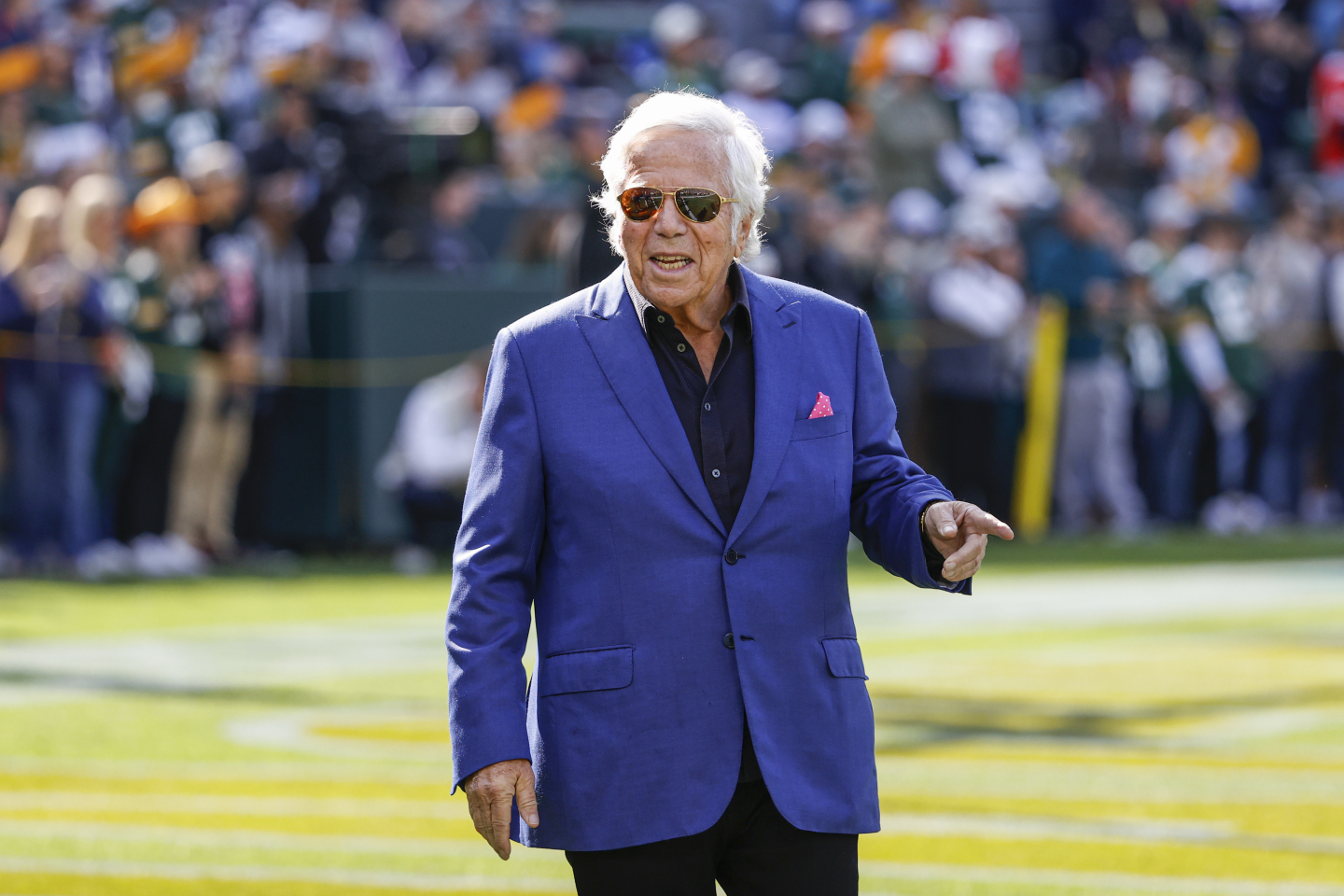
What Robert Kraft Gets Right

There is a lot to criticize about the widely mocked Blue Square Alliance Super Bowl ad. In it, two bullies knock into David, a Jewish boy, and attach to his backpack a yellow sticky note with the words “dirty Jew.” A taller boy with a deeper voice puts a blue sticky note on top of the yellow one, telling David, “Do not listen to that,” and “I know how it feels.”
David’s savior is Bilal, a Black student with a Muslim Arab name, who stops David from directly addressing the antisemites. After covering the antisemitic note with his blank blue one, with no explanation, he attaches another blue sticky note to his own chest.
Setting aside the preference of many critics to focus on Jewish strength and pride—because perceived weakness seems to motivate antisemites—the entire scenario is unrealistic.
While it’s certainly possible for a Jewish student to have “dirty Jew” hurled at him, that kind of rhetoric circulates mainly in the cesspits of social media. The antisemitism students say they face in school is different. It is more likely to include being called “settler colonialists” and “genocidal baby killers,” being told “Zionists” are “not welcome” and “resistance is justified,” and hearing annihilationist chants like “globalize the intifada,” “there is only one solution—intifada revolution,” and the Hamas slogan “from the river to the sea.”
To be sure, some Arab Muslims and Black public figures do stand up to antisemitism. Notably, Arab Muslim peace activists Loay Alshareef and Amjad Taha, American political figures Van Jones and Ritchie Torres, and Turkish-born Muslim American Enes Kanter Freedom vocally oppose all forms of antisemitism, including the antizionist mutation of the anti-Jewish mind-virus.
But in lessons from kindergarten through college, Civil Rights–era Black–Jewish solidarity seems largely absent, if not outright denied. And the “intersectional” alliance between the Black Lives Matter movement and antizionist groups—from “Queers for Palestine” to the Democratic Socialists of America to various Arab and Muslim coalitions, at least some promoting explicit terrorist propaganda, and almost all failing to condemn the sexual violence perpetrated by Palestinian terrorists against Israelis—has created more tension than collaboration between Jews and other minority groups on campus.
Even the most anti-Jewish groups on the left, however, are careful to avoid explicit old-school antisemitism like calling someone a “dirty Jew.” Many who say—and may even believe—that they oppose antisemitism still engage in today’s most popular version of it.
Antizionists like Ilhan Omar, Rashida Tlaib, Linda Sarsour, and their ilk oppose the Nazi/white supremacist version of antisemitism—explicit rhetoric portraying Jews as non-white—while denying the anti-Jewish nature of their own ideology. That ideology accuses Jews of being “white settler-colonialist oppressors” while denying Jewish peoplehood as well as Jewish indigeneity and the legitimacy of Jewish sovereignty in the Land of Israel.
The “dirty Jew” form of antisemitism is easy to oppose while maintaining a profoundly anti-Jewish stance. Even New York City’s most prominent crypto-antisemite, Mayor Zohran Mamdani, who denies being antisemitic yet refuses to acknowledge that the chant “globalize the intifada” is a call for violence against Jews worldwide, would, I’m quite certain, oppose calling someone a “dirty Jew.”
We gained insight into this sleight-of-hand when “Palestinian Assembly for Liberation” demonstrators in Queens chanted “Say it loud, say it clear, we support Hamas here.” The newly elected mayor issued carefully worded statements: “The rhetoric and displays [emphasis mine],” he proclaimed, were “wrong and have no place in our city.” On social media, he posted: “Chants [emphasis mine] in support of a terrorist organization have no place in our city.”
In other words, supporting Hamas—even in front of synagogues—is not the problem. The problem is rhetoric that makes it obvious. Stick to slogans that still fly under the radar—like “globalize the intifada.”
Despite all the reasons to be disappointed in Robert Kraft’s ad, however, the Blue Square Alliance gets one thing exactly right. The most important people in any bullying scenario, antisemitic or otherwise, are the bystanders.
In the ad, some children snicker. Others passively wonder whether to tell David what’s on his backpack. Bilal is the only one who speaks to him. Nobody stands up to the bullies.
In any public act of bullying—middle school, university, or social media—the target is never the point. Whether perpetrated by antisemites, mean girls, or cancel mobs, the point is always the bystanders. And bystanders are the ad’s target audience—not Jews under attack, not Jews who fight back, and not non-Jews who already speak up. The ad is directed toward bystanders who aren’t taking action.
Anti-Jewish behavior and sentiment, like other social contagions, increases when it brings more social gains than losses. When bystanders do nothing, it reads as tacit approval and functions as social elevation, emboldening attackers. Research shows that bystanders visibly befriending victims of bullying is protective. The same strategy works against cancellation attempts. And when non-Jews publicly stand with Jews, antisemitism becomes socially disincentivized.
More people in the U.S. reject antisemitic conspiracy theories than accept them. But the vast majority—Jewish or not—remain silent when they encounter antisemitism. Some fail to react because they don’t recognize it unless it looks like “dirty Jew.” Many who do recognize it fear reputational, professional, social, or physical retaliation. And insufficient public opposition is a major reason antisemitism continues to rise.
Tucker Carlson’s popularity has grown as his anti-Jewish conspiratorial rhetoric has become more blatant. Surveys have found that significant shares of younger Americans lack basic Holocaust knowledge, express uncertainty about whether it occurred, and even endorse conspiratorial narratives blaming Jews. Younger Americans are less likely to view antisemitism as a serious problem than older Americans even while they report witnessing more of it.
Accurate information matters. But as Bret Stephens, Pulitzer Prize-winning New York Times columnist, observed in his State of World Jewry address, “the world has never suffered a shortage of educated anti-Semites.” Anti-Jewish bigotry, he argued, reflects a psychological reflex that cannot simply be educated away.
It is, however, socially contagious. And contagious phenomena can be contained. That is what the Blue Square Alliance attempts to do. The campaign can reach the roughly two-thirds of Americans who do not hold antisemitic views but say they are unlikely to intervene.
Jews are such an obsession for so many, that although there are only 15 million worldwide and under 8 million in the U.S., it can be easy for people (like Joe Rogan) to think Jews number at least in the hundreds of millions. We may punch above our weight, but there are social media influencers with more followers than there are Jews on earth.
Jews are too small a minority to counter antisemitism alone. But not only do almost half of Americans think Jews can handle antisemitism on our own, perceived social disapproval for ignoring antisemitic discrimination is declining.
Posting a blue square may seem insignificant, even silly. But the premise is sound: When enough people publicly signal solidarity and support for Jews, anti-Jewish hostility becomes less appealing. The more people signal opposition, the more others become willing to do the same, visually demonstrating that antisemites are in the minority.
US Army Master Sergeant Roddie Edmonds, who will soon be posthumously awarded the Medal of Honor for his actions as a Prisoner of War during WWII, was ordered by a Nazi to identify the Jews among the American POWs. Edmonds had the moral clarity to refuse, insisting that roughly 1000 non-Jewish POWs stand together with 200-300 Jewish American POWs. “We are all Jews here,” he told the German officer. Those Jews survived because Edmonds understood the reality of safety in numbers.
This is the fundamental truth the Blue Square Alliance gets right. No matter how strong we are or how much we “lean into our Jewishness,” as Stephens wisely advises, wherever Jews are a minority, we rely on those who don’t hate us to stand with us.
Until a critical mass is willing to publicly oppose antisemitism and the falsehoods that sustain it, too many Davids will be pushed around in school, too many universities will remain hostile to Jews, and too little courage will be displayed for Jews to be protected.
Pamela Paresky writes for Psychology Today. She has taught at Johns Hopkins, the University of Chicago, and the US Air Force Academy, and is currently a Senior Fellow at the Network Contagion Research Institute and an Associate at Harvard University in the Department of Psychology.
