




The Grand Valley
18. We get a little abstract and we make up a bunch of words and phrases in order to describe what Joan Mitchell was doing on the canvases she painted in 1964, a kind of annus mirabilis for Joan Mitchell in which she obliterated herself and therefore also became most herself.
BEFORE JOAN MITCHELL moved out to Monet’s part of France, before Jean-Paul Riopelle ran off with the dog-walker and while she was still in the heyday of her greatest period of artistic ferment, around 1964, she painted a number of canvases that are mostly just centers. I love these paintings so much that I don’t really want to talk about them.
To be a true lover of Joan Mitchell would be simply to look at these paintings and to be with these paintings, to spend time with these paintings and slowly to allow these paintings to make the divots in one’s soul-space that they will eventually make. And then, just to shut the fuck up. That would be the purest thing to do.
But then a second thought comes. What about the fact that I am not pure? What about the necessary job of being the individuated person-thing that I am and that you are? What about Carl Gustav Jung smiling at us from across his idiotic clinician’s desk and winking at us with the knowing wink? What about the fact that Joan Mitchell stabbed almost everyone she ever cared about in the back? She could turn on anyone in a second. She could betray anyone. Is being true to Joan Mitchell then being willing also to betray her in kind? To attempt to say more than she would ever have wanted anyone to attempt to say? And then also of course to fail. To look back at the empty words and realize that they say nothing, just as Joan Mitchell realized, again and again, that her canvases were nothing, that they achieved nothing at all.
The year 1964, anyway, was a good year. There’s a work, Untitled, from that year that is a giant mass of green that takes up most of the canvas. And then there are all kinds of spongies and skoogies around the outside of the dark green center. Like looking into the mass of green stuff that is a spot of happening and then just not knowing what the hell to do with that mass of stuff that densifies itself and takes over the seeing that is a seeing into nothing, a seeing that goes beyond this centrifuge of green, or is pulled down into it and becomes a seeing that is beyond seeing. And then the outer scritchy scratch shows us how the density of green lets loose and gives way to something lighter and less dense. This is how the world is ordered, though it is ordered like that more in some places than in others. What I mean is that the world is always ordered in this way, but in some spots it seems to be more what it is than it is in other spots. Of course, that’s not really possible, since the world is exactly what it is everywhere and at all times. That’s true. But also, the world is more what it is in some places and at some times. These two facts sit uncomfortably alongside one another.
Joan Mitchell had a deep sense for the double and seemingly contradictory special / not-special nature of all experience, and I suppose this mix of density and scritchy scratchy at the edges was how the world was ordered on the western coast of Corsica and other spots around the Mediterranean in the early 1960s. Joan Mitchell was sailing around in the Mediterranean during loungy long days with friends and in the midst of a kind of ongoing fuckfest with Jean-Paul Riopelle, and it was all a matter of moving along freely and then hitting these punctuated densities of intense and dark green. It was landscapes that were suddenly concentrated here and there. You are floating through the ancient waters of the Mediterranean Sea and your own being is kind of floating there also in the mode of lounging and drinking and occasional screwing and seeing things hazily and then suddenly with moments of clarity and feeling certain moments with intense pangs of self-awareness that then hollow out into a not-entirely unpleasant emptiness, the emptiness of a fullness that hovers at your periphery. And Joan Mitchell was fascinated by these happenings of densification, by the focus and the holding of these spots. The moments in time and the specific sites along the coasts of various islands in the Mediterranean are focused and holding, and they create a focus and a holding in the beings who come near to the focus and holding and are thereby, themselves, focused and held.
So the paintings that Joan Mitchell made are a focus and holding and also carry that focus and holding forward. They continue the process of being focused and held and of focusing and holding in those who experience the canvases. They make the chain of focus and holding longer and extended, and they allow that focus and holding to happen, now, wherever the paintings happen to be. The focus and holding and the release into scritchy scratch that exists in actual spots along the coast of Corsica are now also extended and real on the canvases that Joan Mitchell painted, these canvases no longer being tied directly to those spots in the Mediterranean in the summer of 1964 but now extended far beyond that in space and time and yet, at the same time, in a crucial way, always tied down and always connected directly to the focus and the holding that was right there at specific spots as Joan Mitchell was focused and held in her entire being as she experienced and, in a sense, was experienced by the spots of density along the coast of Corsica during one particular summer of her life.
The densities carry a sense of a holding and a density of being but also an obliteration. That’s the other thing. There is fear at the heart of those dark masses that Joan Mitchell created and recreated many times on canvases in 1964. You get sucked into those dark centers and the palpitating something or other that is in there, the fear in these centers of swirling green surrounded by the scritching and the scratching at their outer boundaries, the dread that can be found in these inner places is also a seductive dread. There is something going on in there, some secret being tantalized at the edges.
Even Chicago gets this treatment. Chicago of 1964 is another dark blob, like the dark blob at the center of Untitled and at the center of Girolata Triptych, but this time the blob is filled up and modulated by all kinds of blue. Maybe the blue is the less organic version of the same thing that beats and throbs at the center of the Mediterranean blobs. Chicago is the colder version of the same thing she is trying to show in, say, Calvi also from 1964. The green / black mass in Calvi is situated a little more at the top and to the right portion of the canvas. This makes sense because when you are looking at Calvi, the town of Calvi in Corsica, you are probably looking at it from the side or from out in the water and you are always looking up a bit, at least if you’ve been sailing around on boats here and there in the Mediterranean Sea and feeling the emptiness of the horizon always out there at the edges of the sea, but also seeing that this beckoning horizon gives way to the looming presence of rock and seashore and vegetation and the presence of something that breaks the horizon as this or that island comes into view. The fort at the tip of Calvi is perched there on the rocks just above the sea. It is perched there and it just draws you out there and extends you up a bit as it draws out to the tip of the mini-peninsula there and just raises you up a touch. And that’s what the painting Calvi does. The painting doesn’t show you the visual look of Calvi, not in any recognizable way. No one could pick out the town of Calvi just by looking at Joan Mitchell’s painting called Calvi. But the scritching and the scratching that is the presence-being of Calvi as the town moves toward its density out at the tip—that’s there on the canvas by Joan Mitchell. And the way the town takes you out and then just lifts you up into a density and a holding and a focus that comes to something extraordinary, actually, something wonderful and scary and true, just the way that the world can resolve itself into certain densities, and the way that the holding and focus is so stunningly and really and truly there.
Or sometimes Joan Mitchell painted an area that has nothing to do with human densifying. That’s to say, she was interested in the way that towns and cities and places of human interaction have their densifying. But she was also aware that human densifying is not the only densifying. She liked how trees could get all groupy together, for instance. So maybe she’d paint a copse of trees. Those masses of bark and expansions of leaves can get hold of an area and make it coalesce into a density and make a focus and a holding happen. Those trees will sometimes get together and do that, yes they will. The trees somehow also can get it into their heads sometimes to stretch a landscape all out horizontally and to create the wideness of the world, to participate in the widening of the world. But other times the trees have a different idea and they get all densified. The trees, sometimes, are interested in the tightness and the compression of being that a certain amount of tree intensification and huddling about one another can bring to the space.
Or sometimes maybe it is just one tree. One tree can make a stand in the world. One tree can establish a spot of being. Not all trees can do this. Different trees have different characters. Some trees would just never have it in them to make a density no matter how hard they tried. Most trees just never try. Probably, it is too difficult. But other trees get it into themselves to make a density just of their one tree-ness, their single being. That’s what Joan Mitchell is paying attention to and letting pass through her and onto the canvas in First Cypress from 1964 and also Blue Tree from that same glorious year.
The year 1964, it should be clear, is my favorite year of Joan Mitchell. There are other incredible years. But in 1964, in that annus mirabilis, the densities and the holdings and the focuses are shown on the canvases and are carried into the canvases and exist on those canvases now for as long as those canvases will exist. Those canvases are the existing and the re-existing of the densities that were in the world when Joan Mitchell—that specific combustible person—went through the world at that specific time and took into herself those things, the no-space and the nothing-zone that was her being in the world at that time, she vacated herself and let the densities in and, at the same time, the densities that came in hit upon particularities that were Joan Mitchell and which are the mystery of the fact that a person, Joan Mitchell, was completely penetrable by the densities and focuses and holdings that were being offered to her along the coast of Corsica and in other places, and even as she took on those densities and focuses and holdings, she herself was also a space of density and focus and holding, a specific way of being in the world that was filled with its own porosity and resistance in the specific pattern that constituted Joan Mitchell instead of some other being-in-the-world.
She allowed herself to paint that, or she became the reality of what happens when that specific coming-to-be-a-set-of-densities and a kind of holding and a focus happens in the world in this or that place and then carries through into a being-in-the-world that is present for it. She became that. She was ready to be that and allowed herself to be that and this is what then happened through her onto the canvas.
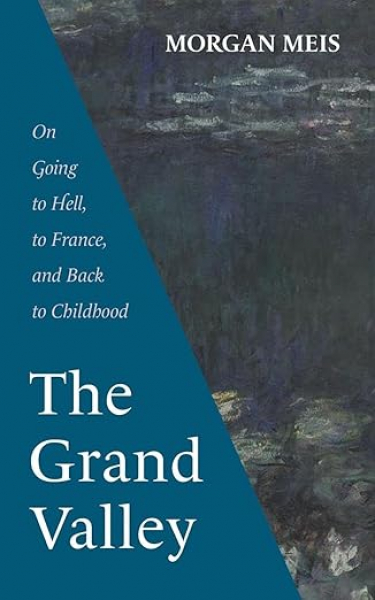
Excerpted from The Grand Valley. Reprinted with the permission of the publisher, Slant Books.
Essayist and critic Morgan Meis writes about art and culture for newspapers and magazines including The New Yorker, Harper’s, n+1, Slate, Virginia Quarterly Review, and The Believer, and was the critic-at-large for The Smart Set, an arts magazine at Drexel University. A co-founder of the arts collective Flux Factory, he is also an editor at 3 Quarks Daily. He holds an MA and a PhD from the New School and a BA from Eugene Lang College, where he has also taught philosophy. He is the recipient of a Creative Capital/Warhol Foundation Arts Writers grant and a Whiting Award in Nonfiction. In Ruins (2012), his book of essays on art, literature, and contemporary life, he explores the idea that we only understand our experiences after we have already lost them. His Dead People (2016, co-authored with Stefany Anne Golberg) is a book of eulogies for notable figures. He currently teaches contemporary art and philosophy at the College for Creative Studies in Detroit.
