




The Soft Bigotry of Affirmative Action

The ability of racial preferences to stigmatize black achievements first hit home for me in college in the early 1990s. Just before the start of my senior year, I received a job offer from the local newspaper. A short time later, I happened to run into a former editor of the college paper where I had previously worked and told her the news. “Congratulations,” she said. “I heard they were looking for more minorities.” We were on friendly terms, so I don’t think it was her intention to offend, but the remark still stung. For me, the episode illustrated one of the major downsides of affirmative-action policies. No one with any self-respect wants to be perceived as a token, whether in the workplace or on a college campus, and racial preferences can facilitate those kinds of assumptions even for the most accomplished black professionals.
In his memoir, the black scholar Thomas Sowell described the change in how black success was perceived by others over the decades. “One of the ironies that I experienced in my own career was that I received more automatic respect when I first began teaching in 1962, as an inexperienced young man with no Ph.D. and few publications, than later on in the 1970s, after accumulating a more substantial record,” he wrote. “What happened in between was ‘affirmative action’ hiring of minority faculty.”
To illustrate the point, Sowell recounted a student approaching him after class at UCLA, where he taught economics in the 1970s. The student was having trouble understanding something in the textbook, and Mr. Sowell explained to him what it meant. “Are you sure?” the student said.
“Yes, I'm sure,” Sowell replied. “I wrote the textbook.” The student then noticed the professor’s name on the cover and was “obviously embarrassed,” Sowell wrote. “It was one of the signs of the times, one of the fruits of “affirmative action.’”
A similar personal story about white perceptions and black self-doubt is related by the black economist Walter Williams, who taught at Temple University in Philadelphia in the 1970s:
[M]y duties included teaching the PhD microeconomics seminar and serving on the PhD examination committee. Having a black student in my graduate class was rare. During the first few class meetings, some of the whites would ask searching questions that sometimes required that I go through a mathematical proof.
Although I never suggested this to students, it was my impression – not born of paranoia, I trust – that they were testing my credentials, checking to see whether I was competent in my subject. I’d simply answer their question and move on. After a few classes that kind of questioning stopped. In the rare cases when the class did include a black student, who might have sensed what was going on, I could almost read a sigh of relief on his face. Maybe he said to himself, with relief, “The brother could answer the question!”
Sowell considered it fortuitous that his academic achievements predated racial preferences. “My academic career began two years before the Civil Rights Act of 1964 and I received tenure a year before federal ‘goals and timetables’ were mandated under affirmative action policies,” he wrote. “[T]hese facts spared me the hang-ups afflicting many other black intellectuals, who were haunted by the idea that they owed their careers to affirmative action.” Another way that timing worked to Sowell’s benefit? “I happened to come along right after the worst of the old discrimination was no longer there to impeded me and just before racial quotas made the achievements of blacks look suspect.”
Future Supreme Court Justice Clarence Thomas, who graduated from Yale Law School in 1974, recalled that he was treated “dismissively” at the time by job recruiters, who “asked pointed questions unsubtly suggesting that they doubted I was as smart as my grades indicated.” Eventually, he stopped pursuing work in a big-city law firm and accepted a job in the state attorney general’s office in Missouri. “Now I knew what a law degree from Yale was worth when it bore the taint of racial preference.” Thomas has been labeled a hypocrite for opposing racial preferences because he supposedly benefited from them as a college student, yet no one has produced evidence that race played a role in his admission to College of the Holy Cross or Yale Law School.
According to press accounts, he was recruited to Holy Cross by a dean, John Brooks, who wanted to increase the number of black students on campus, but Thomas has long denied that story. He started college at Immaculate Conception, a seminary in Missouri, but left after a year and returned home to Savannah, Ga. In his memoir, he said that he applied to Holy Cross at the urging of a nun who had taught him in high school. “I ranked near the top of my class at Immaculate Conception, so Holy Cross had quickly accepted my application,” he wrote. “The only problem was money, but the director of financial aid told me that something could be worked out.” It’s true that some black students who had been contacted by Brooks were admitted to Holy Cross the same year that Thomas transferred there, but the justice has shot down the suggestion that he was one of Brooks’s recruits. “A nun suggested Holy Cross. That’s how I wound up there,” he told a reporter in 2007. “Your industry” -- the media – “has suggested that we were all recruited. That’s a lie. Really, it’s a lie. I don't mean a mistake. It’s a lie.” The “thing that has astounded me over the years is that there has been such an effort to roll that class into people’s notion of affirmative action,” he added. “You hear this junk. It’s just not consistent with what really happened.”
Nor is there any evidence that Thomas, who turned down offers from Harvard Law School and the University of Pennsylvania Law School, was admitted to Yale Law School under its affirmative-action program rather than through the regular admissions process. He had graduated from Holy Cross ninth in his class (of more than 500 students). According to the New York Times, eight Holy Cross graduates were admitted to Yale Law between 1968 and 1978, the decade that included Thomas's law school career. Why assume that he got in only because of his race? Why question Thomas’s credentials but not those of Bill Clinton or Hillary Rodham, two of his fellow Yale Law students? The reason is affirmative action, which has helped to delegitimize black academic and professional success.
Chief Justice John Roberts's majority opinion in Students for Fair Admissions v. Harvard stressed that race-conscious admissions violate the Equal Protection Clause of the 14th Amendment. But that’s not the only problem with them, and Thomas performed a public service in his concurrence by detailing the harm that racial favoritism inflicts not only on those from non-favored groups but also on the intended beneficiaries. When blacks and Hispanics “take positions in the highest places of government, industry or academia,” Thomas wrote, “it is an open question . . . whether their skin color played a part in their advancement.” He spoke from experience.
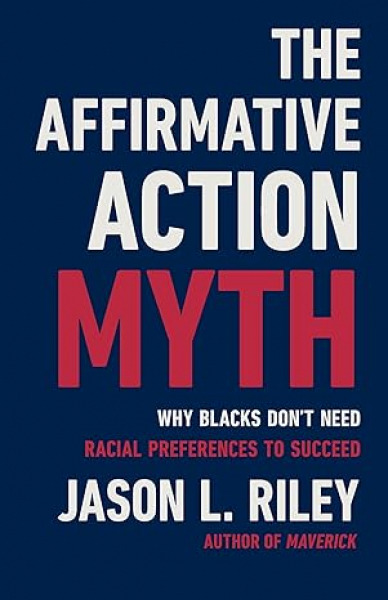
Jason L. Riley is a Wall Street Journal columnist and Manhattan Institute senior fellow. This article is adapted from his new book, The Affirmative Action Myth: Why Blacks Don’t Need Racial Preferences to Succeed.
