



A Question Well-Posed

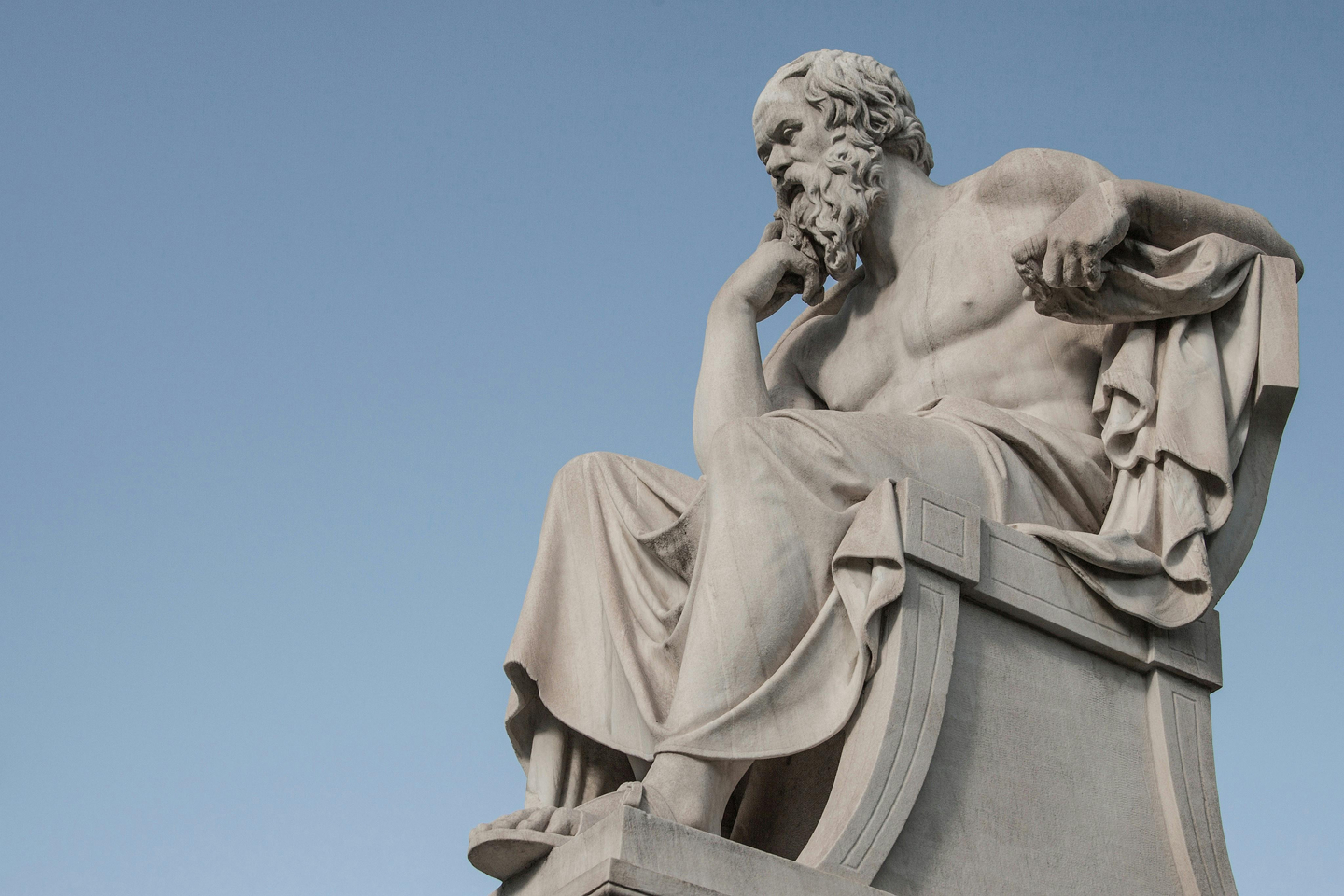
Soren Kierkegaard once remarked that we can never be reminded too often that a man existed named Socrates. Agnes Callard’s Open Socrates thus comes as a particularly timely reminder. Callard is a professor of philosophy at the University of Chicago, focusing on ancient philosophy and ethics. Due to what’s called the “linguistic turn,” academic philosophy can often feel like a boring exercise in analyzing terminology and quibbling about what people are allowed to talk about. Callard breaks this mold. She is distinguished in her field by being interested in philosophy that is practical and humanly valuable; she is very much in touch with what gets people interested in philosophy in the first place—a desire to understand how to live, to find answers to the big questions, to solve the meaning of life.
It is easy to lose faith in the power of a question well-posed. People routinely dismiss philosophical conversations as “dorm room debates,” something you grow out of when you “enter the real world.” We hear this all the time. It belies the casual assumption that we should just grow up and select some standard prescribed path through life, without inquiring too much into the nature of that path, who planned it, and where it leads. We should avoid what Callard calls “untimely questions” and stick to the ruts of the road more travelled. The assumption, as she puts it, is that you can live a perfectly happy life without philosophy, which is just the plaything of college students and academics. But what if you can’t?
At the beginning of Open Socrates, Callard shows how this crisis of faith in the meaning-finding capacity of human beings afflicted one of the greatest novelists of all-time, Leo Tolstoy. Tolstoy lost faith in his own capacity to answer the basic question of how one should live, which led him into a state of suicidal existential despair. Eventually, he was rescued from despair by embracing specific religious and moral principles. Callard claims, however, that Tolstoy apparently never tried to answer the question that so troubled him before he fell into despair. He assumed that the intellect was not up to the task. Her book argues that Socrates showed a different path, one that finds the process of trying to answer vital questions exhilarating rather than dread-inducing.
It is far easier to assume the socially given answer to the question of how one should live or to relent to the body’s own imperatives. Callard calls these the “savage commands” of the body and of society, and she argues that Socrates showed a third way beyond these commands. The “savage commands” are the underlying determinants of the dominant schools of ethics, in her view, with the bodily commands structuring utilitarianism—maximizing pleasure for the greatest number of people—and the social commands structuring Kantian ethics—only doing that which, if everyone else did it, would prove beneficial. Additionally, she sees Aristotelian ethics as an attempt to harmonize both commands.
Callard holds up what she calls Socratic ethics as an alternative to these major ethical schools. Rather than remain obedient to the body or to society, Socrates seeks the truth through a process of inquiry that necessarily involves another person, leading to a path of mutual discovery. Callard disagrees with the standard position that Socrates is primarily ironic, that he already knows the answers, and only seems to let the person he is questioning arrive at them on his own. Instead, she posits that Socrates’ project is fundamentally in earnest, that he genuinely means it when he says that he knows nothing and wishes to act as a neutral and unbiased interlocutor.
Callard’s work is refreshing in that, rather than cynically dismissing the search for answers to the big questions or retreating into an agnostic position, she charges full on toward the meaning of life. While academic analytical philosophy frequently finds itself in flight from ever answering a question that would change anyone’s life, Callard cheerfully lacks this aversion. She is totally sincere.
Many readers might not fully assent to Callard’s contention that the intellect can arrive at the answers. (She admits that her approach to Socrates is one of “hardline intellectualism.”) It is difficult to deny the force of Pascal’s famous assertion that “the heart has its reasons, which reason knows not.” This was partly my own reaction. But Callard staves off this objection. She argues that we can’t arrive at the truth purely in isolated intellectual contemplation. We require partners in Socratic dialogue, who allow for miraculous moments of revelation. Socrates doesn’t engage in dialogue as a bid for social approval or merely as a performance but always attempts to speak directly to the soul of the person he is addressing. Callard writes, “Speaking to the soul of a person—which entails letting them talk back to you—allows you to share something with them that you don’t have.” This is beautifully put and speaks to the moments of self-revelation so many of us encounter when we find ourselves saying something we never expected to say. Callard quotes Socrates himself on this subject: “Then if the soul, Alcibiades, is to know itself, it must look at a soul, and especially at that region in which what makes a soul good, wisdom, occurs, and at anything else which is similar to it.”
At the very least, I think most us of would admit that the intellect has some part to play in the process. It gets the ball rolling. I’m grateful specifically for Callard’s capacity to live life as a process of questioning and to find this process invigorating rather than nauseating or terrifying. Despite how much discourse and debate is readily available to us online, it can feel like the quality of being inquisitive is rather rare. So much discourse is just grandstanding, and it is hard to penetrate the murk and locate genuine curiosity and sincerity. The forerunners of such people are the very sophists with whom Socrates sparred. Callard provides a curiously contemporary-sounding description of their mode of operation: “Orators characteristically hold their audience in contempt […] which means that they cannot get, from that audience, the validation they seek. Constantly chase superiors until I run out of them and hold everyone in contempt, and have nothing—this is not a coherent project.”
By contrast, Callard’s Socrates is inspiring because he genuinely wants to know. He is an exemplar of conversational respect, taking his interlocutors and their capacity to access the truth seriously. While Socrates was outwardly homely, his student Alcibiades said, “I had a glimpse of the figures he keeps hidden within: they were so godlike—so bright and beautiful, so utterly amazing.” Kierkegaard was right that we can never be reminded too frequently that such a person once existed—and the reminder, in the present moment, proves particularly piquant.
Sam Buntz writes from Chicago. He is the author of The Great American Cougar Hunt and The God of Smoke and Mirrors, both available on Amazon. You can find him on Twitter @SamBuntz.
