




America’s Artist
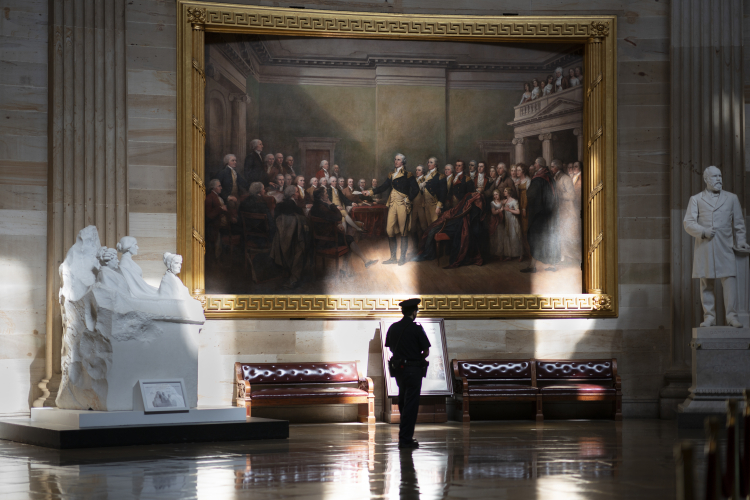
We have seen, be it in person or in a photograph, the famous painting depicting the signing of the Declaration of Independence. Populated by important men of the American Revolution, most prominently we see George Washington, Benjamin Franklin, Thomas Jefferson, and John Adams, the painting a visual representation of the American founding and most importantly, the American story.
We know the painting but do we know the painter? Do we know whose hand depicted this occasion that created a new country, free of the monarch’s oppression? It was John Trumbull and his story has been told by Richard Brookhiser in his new book, Glorious Lessons: John Trumbull, Painter of the American Revolution.
Brookhiser’s gift as both writer and historian shines in this book that seeks to illuminate the canvas of Trumbull’s life. One may picture Brookhiser (or any biographer for that matter, but it is especially true in this case) sitting patiently, cleaning the griminess on the metaphorical canvas, as more true details of Trumbull’s life emerge, and a picture is revealed of a man with unique temperament and indeed unique patriotism as well.
Born in 1756 and died in 1843, John Trumbull (like many of his American contemporaries) wasn’t engaged in only one profession. Throughout his life, he was a diplomat, a soldier, and even on a smaller scale, an architect. But it was his gift as an artist that he continuously came back to. As Brookhiser writes, with the help of his brush, “The story Trumbull aimed to tell was the story of the American Revolution…[he] wanted to tell the creation story of America—what it should mean to Americans, and what it could mean to the world, and to the future.”
This need to tell America’s foundational story was not borne out of self-centeredness, as much as Trumbull (like any other human being) painted to make money. It was borne out of an authentic desire to elevate (and most definitely romanticize) the American Revolution and, in Trumbull’s words, to offer a glimpse into the “glorious lessons of their [American people] rights, and of the spirit with which they should assert and support them.”
Brookhiser traces the beginnings of Trumbull’s yearning for painting when he was just a little boy, growing up in Lebanon, Connecticut. Young John would sit on the floor and copy pictures that were painted by his sister. Trumbull’s father, Jonathan Trumbull, Sr. did not really think that his son should endeavor to have a career as an artist. It is not a ‘manly’ thing to do—perhaps not even these days—and his father hoped his son would become a lawyer.
Not much has changed—every parent wants their child to do well and to not live in poverty, although one suspects that Trumbull, Sr.’s opinions about his son’s so-called career as an artist were not merely related to money, but also reputation and social standing.
Still, Trumbull followed his desire, and found himself in London and Paris studying painting from well-known and accomplished artists. Let’s not forget that there was war going on, and the Trumbull family were proudly fighting for America’s independence (Trumbull’s father was, among other things, a governor of Connecticut, who managed the state through those early years of independence).
One of the many interesting aspects of Trumbull’s life was an unfortunate series of events that happened during his time in London as a young, aspiring artist. As Brookhiser writes, “…his [Trumbull’s] studies were cut short in a manner as dramatic as it was unexpected: in November 1780 he was arrested on suspicion of being a spy.” The accusation that landed him in prison wasn’t true but the British authorities didn’t care about the accuracy or veracity of the suspicion. It would appear that they were just using Trumbull in some “tit for tat” venture, and poor Trumbull was the victim.
But he “kept painting in prison. It was both a pastime and a way to maintain his identity in enforced confinement.” It would be months, June 1781 to be precise, until Trumbull was finally released. Time in London proved to be full of strife, but Trumbull’s “journey to America was prolonged by quarrels with the captain, bad weather, and a change of ships after a detour to Spain. Not until January 1782 was he in America once more, a year and a half after leaving it.”
Trumbull’s life is filled with events of perseverance and patience, and this is certainly one of them. It is difficult to not look at Trumbull’s life through the lens of our own time, and to not compare such patience with life itself to our laughable, egotistical, and incredibly impatient society. Is this something unique to Trumbull or did everyone exhibit such characteristics?
The answer, perhaps, lies somewhere in between. Methods of communication alone would have to create a society of patient people, let alone other factors. Trumbull, in this case, wouldn’t be that much different than others. At the same time, however, we witness here a story about a man who doesn’t give up so easily despite the difficulties he has encountered.
Brookhiser’s prose leads us into the lost and found paths of Trumbull’s interior life. I write “prose” because Brookhiser is truly telling a story about real, enfleshed people who not only have minds but also souls that are inextricably connected to the foundation of the United States. It is true that we get to know Trumbull quite well, but even the “secondary characters” are not neglected. Nobody is a cipher. Even a seemingly unimportant acquaintance who had a few haughty comments at some artistic salon in London or Paris is an enfleshed human being. Nobody in this book is a cardboard cutout but actual people we can picture before us.
It is not an easy task to write a book about the founding of this beautiful and complex nation. A writer is often forced to choose between saccharine patriotism in which the Founding Fathers (and those associated with them, like Trumbull) are treated like deities, and disregard for the dignity that they deserve. Brookhiser has a truly wonderful and singular gift at not committing either one of these errors. Instead, we are offered a story that deserves our attention, deserves to be recognized, and even respected. Yet this respect is not synonymous with worship. We observe Trumbull and others around him as full human beings—their faults, their courage, their humility, and their anger—and it is precisely this that serves as an invitation to reflect on not only Trumbull’s life but America’s founding.
With Glorious Lessons, Brookhiser stays true to the American character. There is no mysticism—political, monarchical, or any other kind—that is embedded into the fabric of America. There is hard work, hoping to persevere, and most importantly, hoping to retain faith in God, even if the faith is sometimes thin and weak indeed.
At the center of the American founding is self-rule, and as Brookhiser writes, it “is the first and fundamental right. Others are vital: property, worship, speech. Self-rule may threaten them all, but without it, no lasting defense of any of them is possible. In America self-rule maintained slavery; but self-rule abolished it. Self-rule imposed legal racism; but self-rule overthrew it. Trumbull is the bard, in pictures not words, of American self-rule.”
Although art is in its essence “useless,” it is precisely this “uselessness” that can never be quantified, which gave us John Trumbull’s gift. We look upon his paintings at his implied invitation, wondering who we are as Americans, especially today when all we see is chaos. But Brookhiser’s biography is strangely hopeful—there was great chaos in the past, and somehow people got through it. They fought for what was right, even if they were damn tired of it all. Where exactly America is bound today is open to analysis, but Brookhiser’s fine biography of John Trumbull as the visual chronicler of America’s story is a good place to start—to draw from the well of the past that is not so distant in character and most of all, not so distant in desires.
Emina Melonic's work has appeared in National Review, The New Criterion, The Imaginative Conservative, American Greatness, Splice Today, VoegelinView, and New English Review, among others.
