




VICTIM

Mr. Martin pulled back the curtain. But my real transformation began at Donlon. It makes perfect sense now. Donlon was a whole new ecosystem where I could hone my new superpower.
In fact, it was in one of my very first classes as a college student there—a mandatory sociology class about race and ethnicity—that I learned something profound: I am a victim of systemic oppression. Or, I guess I should say, I was. Now, I’m in some liminal space. Existing in some sort of reverse perjury. My immutable characteristics and “lived experience” no longer count for much. Never did I see that coming.
On that fateful morning in the Donlon auditorium, Professor Gleeson, a rail-thin, balding man, stood in the pulpit of a room with over 300 students. He asked us all to stand, too. He waited until the sound of chairs folding ceased. “Please take a seat if both of your parents are still married,” he said, in a voice that surprisingly carried well, despite his fragile appearance. After looking at each other for a confused second, a large swath of the room sat. “Please take a seat if you have ever attended a private school at any point in your life.” Another large group sat. Rumbles of giggles. People shrugged. Some shook their heads. My seat was near the back of the room. I counted about 50 others standing. “Please sit if one or both of your parents have a University degree.” The group was cut in half. The giggling stopped. All eyes scanned the room, identifying the remainders. “If you have always felt comfortable walking around in your neighborhood at night and have never once feared for your safety, please sit.”
I could have sat. The truth was: I did feel comfortable walking around my neighborhood at night, but only because I’d learned—after a couple of unfortunate jumpings—how to walk in the neighborhood. Cross the street when you saw a group in front of you, stay in the light, go the wrong way if you have to as long as you immediately remove yourself from anything hairy, start to run if anyone behind you follows at least two of your turns, start to run even faster—sprint as hard as you could—if they start to run after you. Simple rules. Nothing crazy. But I still decided to remain standing in the auditorium.
After a week of being on the enormous campus, a week of feeling like an ant among the thousands of students, a week of realizing I was at a severe disadvantage with girls because I hadn’t done anything cool over the summer like backpacking or sailing and because I didn’t play any sports or had any connections at the frats that threw the parties, I knew that I needed some way to stand out. As I stood there in the auditorium, I saw that I was one of only five people remaining. All eyes were on me. Just where I wanted them to be.
“If you have never had any of your family members experience being arrested or incarcerated, sit,” Professor Gleeson said.
Everyone else sat. I almost fist pumped. There I stood: the winner. Tito. I expected the auditorium to burst into applause. But the room was so quiet that if I farted everyone would have heard. I wondered if I was supposed to make a speech or something. But Professor Gleeson simply motioned for me to sit.
I saw a number of heads turn back to look at me. One of the faces was one I recognized. I’d seen her around the dorms and the dining hall and could tell immediately that there was something different about her. One of the most obvious things was that she had an ass that stood out among all the pancake butts I’d seen on my milky white campus. Her ass was the kind I recognized. The kind that was hard to contain, even in baggy sweatpants. She was of a light brown complexion and had vaguely Latino traits—curly hair, a perpetual scowl early in the morning, name-plated gold necklace. If I didn’t know better, she looked like someone who could be from my neighborhood, which felt unique given that everyone else I’d met during my short time at Donlon were from places that sounded like whole other planets to me.
The girl turned back around. I zeroed in on the Apple laptop in front of her. It was not only the latest model, it was covered entirely in stickers that seemed to demand vague, but intense action: Fight the Power! Disrupt! Pay Your Fair Share! I decided she was not of my kind. And yet she was. I was so very intrigued.
Professor Gleeson continued his lecture. He began to explain the term I was vaguely familiar with thanks to Mr. Martin: “privilege.” Then he introduced a new term that would prove arguably more powerful for me: “systemic oppression.” Together, they would soon roll off my tongue as easy as my name and phone number. But at that point, I might as well have been learning a new language.
To explain the terms, Mr. Gleeson described a race, in which the grand prize was the American Dream: a house, a nice car, a family. He drew two vertical lines on his chalkboard to represent a start and finish line. Then he drew dots at various places in between, including one dot far behind the start line. “I would like for us to imagine something. Together, as a class,” Professor Gleeson said. “Take a look at these dots. They are, in a sense, you and I. Here we are, all of us, in this race of humanity, which, for the sake of this example has yet to begin.
“Each of these dots is akin to a runner. Waiting there at the starting blocks, waiting for the gun to go off. Can you see it? Good. Now, I want us to focus over here.” He moved closer to the starting line, closer to the dot far behind it. “Imagine these runners way over here. What will happen to them when the gun goes off?”
Professor Gleeson waited as chair creaks and coughs returned his question. Finally, the girl I’d been looking at raised her hand.
“Those runners will lose. But it wouldn’t be their fault. Because their life, in fact, has been rigged from the beginning. Just as it was intended to be rigged by their scheming overseers over there near the start line. Those white people. The people with the real power that shape this world to their liking, and that also control this, so-called, race on the board.” She stopped and looked Professor Gleeson up and down. “But I’m sure you know all about that.”
I watched as people around me rolled their eyes. I felt like I was missing out on an inside joke. Professor Gleeson shook his head approvingly. “Thank you for sharing, really, thank you.”
“I’m just speaking the truth,” the girl said, sitting down.
“That you are,” he said, clearing his throat. “She is right. Some people will easily finish the race ahead of others and reap the rewards first. Wouldn’t it make sense then, for those people and their families and their future families to have an advantage over everyone else as each successive generation lines up again for the race?” Mr. Gleeson walked over to my side of the room. “Wouldn’t it make sense that we, as a society, would be required to help the people way in the back of the start line? The people who never had a chance to begin with? Those people who desperately need our help?” He looked me in the eyes.
I stared at that lonely dot behind the start line. I realized that he, and probably everyone else in that room, thought that little dot was me. They all thought I needed… support? Special attention? Gifts? Money? I wasn’t sure what exactly, but it all sounded good.
At the end of class, Professor Gleeson called me down to his pulpit. He crossed his arms over his chest and fidgeted. “Thanks so much for participating. I hope that was okay. Are you okay? Do you want to talk about anything?”
The only thing I wanted to do was thank him. But he didn’t let me get a word out.
“I just want to let you know that I’m really glad you’re here. Just know that the exercise was by no means meant to single you out or, like, target you, okay? You don’t feel targeted do you?”
I shrugged. The word “target” made me think of the red laser Pops used to have on one of his guns. Made me remember how I woke up one morning in Puerto Rico and saw the laser there on my forearm and watched it trace its way slowly up my torso. Pops laughed so hard at my shocked face when I realized what was going on.
“No,” I said.
Professor Gleeson exhaled. “Good. Well, just to reiterate, we are lucky to have you here.” He leaned forward. “This school needs you.”
Mr. Martin was right, I thought. What foresight he had. I left the room with my chest out. I walked back to the dorms, passing luxuriously manicured lawns. Since driving onto campus with Mom a couple of weeks before, I hadn’t yet found my footing. In addition to all the activities, all the ice breakers, the constant repetition of my hometown and major that became monotonous and felt so useless, there was also the sheer size of the school that felt overwhelming. Thousands and thousands of students. Like the entirety of Orchard Beach on a blazing summer day. But in this case, the people seemed so different to me.
They drove Mini Coopers around campus, bragged about skiing trips, played Lacrosse and Water Polo—which is apparently a real sport—knew Jay-Z as simply a rapper with a few songs they sort of remembered—not as HOVA—and they loved to walk and get lost in the woods like they were trying to find some hidden civilization. Among them, I often felt left out. Whenever I thought about sharing what I’d done that summer—lugged around boxes in Midtown, watched my friend get sentenced to half a decade in prison upstate, tried and failed to use my acceptance to Donlon as a ticket to getting laid by girls I knew back home—it all felt so worthless, so foreign. And when I did share some of the tragic things about myself those first few days, like Pops dying, or Gio being in jail, when I tried to frame myself as a survivor like Mr. Martin taught me, I was often met with a solemn silence. A glance around confirmed that I had absolutely killed the vibe.
So I stayed quiet for the most part. I became this mouse of a person. The sort of person I never wanted to be.
Which is why I walked with a bop in my step leaving Mr. Gleeson’s classroom that afternoon. I’d felt like I’d finally been noticed. I was no longer just the average freshman trying to find his classrooms and desperate to make friends. I was no longer the kid who hadn’t traveled much, who didn’t understand how colors corresponded to the difficulty of ski slopes. I was someone special. Not just a survivor. But a victim of systemic oppression. Someone who deserved things, like perks, gifts, and grand prizes, just because. Someone entitled to these things.
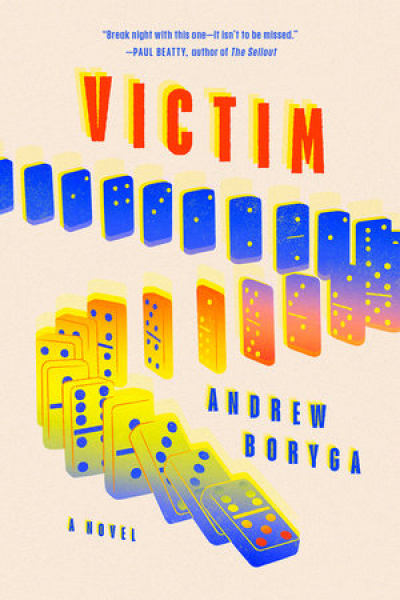
From Victim by Andrew Boryga. Used with permission of the publisher, Doubleday. Copyright © 2024 by Andrew Boryga.
ANDREW BORYGA grew up in the Bronx and now lives in Miami with his family. His writing has appeared in The New York Times, The New Yorker, and The Atlantic, and been awarded prizes by Cornell University, The University of Miami, The Susquehanna Review, and The Michener Foundation. He attended the Tin House Writer’s Workshop and has taught writing to college students, elementary school students, and incarcerated adults. Victim is his debut novel.
