



Inversions, Conversions, Perversions

In an early scene in Lexi Freiman’s new novel The Book of Ayn, the narrator, an Ayn Rand acolyte aptly named Anna, runs into two young women at a “dissident soiree” in Manhattan. She “recognized them from a downtown scene that was vaguely socialist and acutely nihilistic. The two had a podcast and were famous for cooking spaghetti for war criminals and speaking the word ‘retard’ to power.” After a brief conversation concerning waging war against the “Victim Caliphate,” Anna realizes that the duo was a mirror image of her own life. The two podcasters are obvious stand-ins for the real-life hosts of the Red Scare podcast—the center of a countercultural scene that celebrates the canceling of cancel culture.
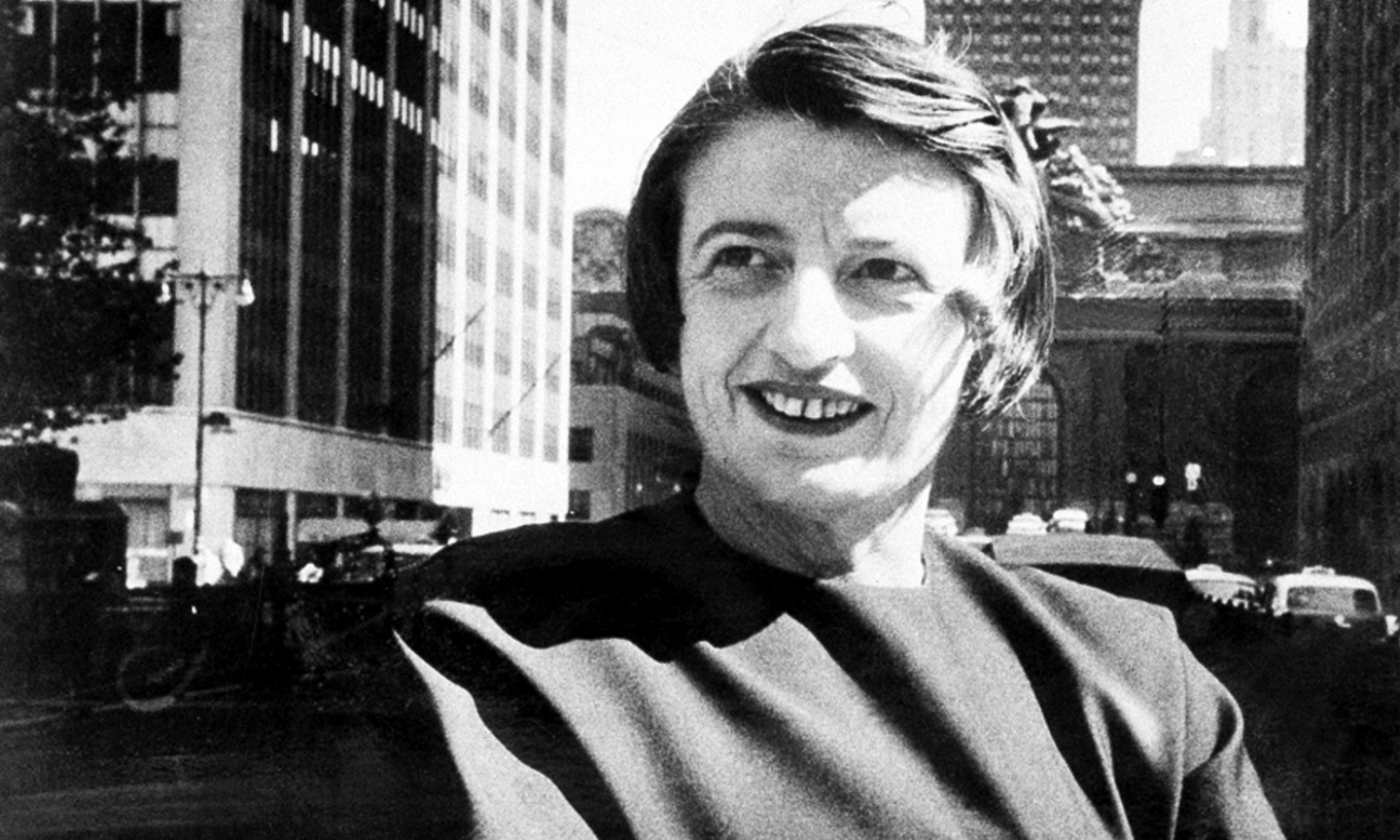
Cancel culture casts a long shadow over Anna’s life: we learn in the beginning that she was unpersoned after being burned by a scalding review of her debut novel, which The New York Times called “classist” for its lackadaisical portrayal of an opioid-ravaged Appalachian town. And to further twist the knife in today’s therapeutic culture, the newspaper of record also labeled her a narcissist. Anna’s defenestration from literary stardom by the guardians of the ivory tower plunged her into so much despair that she turned towards the philosophy of Ayn Rand for assistance. Ayn Rand rejected religions of all stripes, but Anna’s conversion to Rand’s work could best be characterized as a religious awakening—and not the only one she has over the course of the novel.
Despite the way the novel may present itself as political commentary on both cancel culture and Ayn Rand’s philosophy, The Book of Ayn is not political. Unlike Rand’s own novels, which repeatedly hit readers over the head with political overtones delivered via pompous pages-long polemics by larger-than-life superheroes, Anna is the opposite of larger-than-life. She shrinks from life. Life overwhelms her. She can’t refrain from making faux pas after faux pas at events she attends and inevitably hastily flees from. She’s part of the ever-expanding canon of “sad girl literature.”
Charlotte Stroud sketches the contemporary sad girl trope: the “the depressed and alienated woman” whose “knowledge of intersectional theory has left her crippled by a near constant anxiety about power imbalances and inequality” and “is also perpetually worried, to the point of exhaustion, nay burnout, about the plight of the individual under capitalism.” As an Ayn Rand worshiper, Anna is obviously not like that. She loves the individual. She loves capitalism. She loves inequality. She’s no Sally Rooney socialist. She’s not like normal people. Her morality is an inversion of what she calls slave morality—the morality that Friedrich Nietzsche claimed the masses were under the spell of, and the morality that Ayn Rand savaged in her philosophy.
Also, Anna is not a girl but a woman—a thirty-nine-year-old woman who tries to freeze her eggs before being told by the doctor that she doesn't have enough of them to justify the procedure. Like the real Ayn Rand, Anna seems destined to be childfree.
Anna is infatuated with young men. The bulk of the book focuses on Anna’s attraction to an assortment of young men, which she positively compares to Rand’s own relationships with men far younger than she—men who admired her for her intelligence and individuality. Over the course of the novel’s 200-something pages and globetrotting locales, Anna attempts to have flings with various young men that she never reveals the names of, instead bestowing them with nicknames. With her embrace of Nietzschean master morality and somewhat-perverted love of young men of questionable legal age, Anna may best be described as having a Bronze Age mindset—an inversion of contemporary Christianity-derived ethics.
“Women are very borderline,” Anna tells a potential lover, which she calls Big Boy. “They might want to be your wife but might also want to kill you.” Big Boy knows this, as he is still jaded from the fallout of false accusations made by a mentally-ill ex-girlfriend. Anna doesn’t seem to care—she likes the sound of her own opinion. Anna is chock-full of statements that would get her canceled, and often tries to invert feminism for her own purposes. She inverts contemporary discourse over age gaps and power imbalances by proclaiming that “Young men loved older women. It was about power and it was fantastic.” In doing so, Anna inverts an age-old discourse into one of female empowerment—a feat that Nietzsche and Rand would have been impressed with as an example of master morality.
After a series of unfortunate events, the latter section of the novel shifts to the Greek island of Lesvos, where Anna attends a spiritual retreat. The books Lolita and Eat Pray Love are name-dropped towards the end of the novel, yet both books don’t seem fitting to describe the adventures of an iconoclast like Anna. The pages of Lolita are painted with purple prose, whereas The Book of Ayn plumbs the depths of literal toilet humor to smear the pages with crass poop jokes. And while I’ve never read Eat Pray Love, I doubt that a memoir about an older woman lusting over potential newly-postpubescent paramours would ever be a worldwide phenomenon like Elizabeth Gilbert’s was. Instead, the book would likely be canceled—just like Anna.
In a sense, the whole book, while not explicitly being political, can be read as a meditation on cancel culture. Anna’s attraction to young men can be viewed as a new twist on an old discourse about sex and power—one that constantly pops its head into mainstream discourse like an unwhackable mole, from Aziz Ansari to “Cat Person.” In contemporary cancel culture, the scapegoated subject is scanned for deviations from slave morality—a practice deeply rooted in Protestant ethics. By converting to the ethics of Ayn Rand’s inverted morality—master morality—Anna frees herself from the shackles of cancel culture.
Is Anna problematic? Is she sexist? Is she racist? Is she homophobic? Is she transphobic? Is she being classist again, like her first novel was? Does she cause harm to marginalized groups? Are her descriptions of borderline personality disorder ableist? What about the power imbalances? Is it okay for an older woman to develop a relationship with a much younger man, even when the man is above legal age? Would it be different if the genders were swapped? And Eat Pray Love? Shouldn’t it be Eat Prey Love for her and her problematic age gap relationships? Should she be canceled? Wait, wasn’t she already canceled? Can we cancel her twice?
Such questions are those that may be posed by the same people that canceled Anna the first time. But now she has a new book. It’s called The Book of Ayn. And she’s not about to be canceled twice. In today's anxious age, where society's seeming secularization has led to frantic searches for shared senses of meaning, Anna serves as one example of what may come to be.
Sheluyang Peng is a writer living in Sunset Park, Brooklyn.
