




The Dropout Innovators

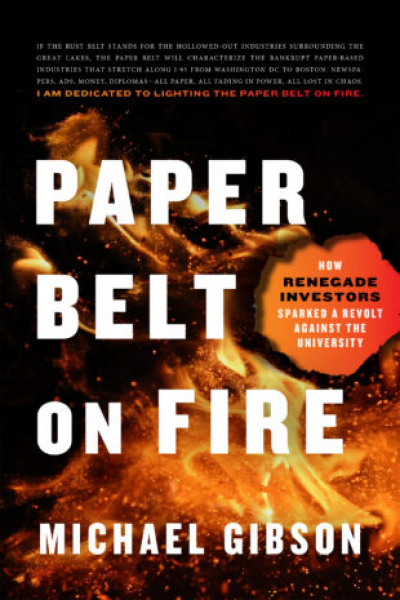
If history is philosophy teaching by example, then "Paper Belt on Fire" is proof of concept. The ‘history’ in question is the author’s personal journey from disillusioned Oxford philosophy PhD student to co-founder of a fund that lures young innovators to realize their dreams by avoiding academia. Michael Gibson’s tale of self-discovery is mediated by a life-changing apprenticeship with that most cerebral of venture capitalists, Peter Thiel. Among other things, Gibson has provided the most sophisticated and sympathetic account of Thiel’s thinking yet to appear in print. But the book is much more than that.
Gibson’s fund is called ‘1517’, after the year that Martin Luther nailed his 95 theses to the Wittenberg church door, thereby launching the Protestant Reformation. Luther’s multi-level critique of the Roman Catholic Church is matched by Gibson’s bill of charges against today’s university. At the most obvious level, universities fail to deliver on their own promises. Not only do degrees fail to secure employment for graduates but more importantly the ‘education’ that students receive in pursuit of those degrees is mainly about imitating received authorities. This charge cuts across both the sciences and the arts.
Most academic research amounts to incremental improvements on what others – the same others – have done. Pareto’s Law roughly applies to who gets credit: 80% of academics cite the same 20% of colleagues in their articles. In some fields, the ratio is even more disproportional. The bottom line is that the many must build on the few, simply to achieve any recognition. Economists call this ‘path dependency’, and it is the bane of technological innovation. As the ranks close around the market leader, the will and imagination to make genuine breakthroughs also close.
Gibson draws on Thiel’s philosophical inspiration, René Girard, to offer a deeper diagnosis of this situation in terms of ‘mimetic desire’. People tend to want what others want and thereby lose the capacity to want at all. Perhaps this is the dark side of efficiency: We forget the sacrifice needed to get what we now take for granted, which then renders us incapable of doing something similar in the future. Gibson interestingly parlays this insight into a justification of Blockchain technology as an alternative to ‘trusted third parties' in financial transactions.
This debilitating tendency extends to the humanities, which has a passive-aggressive attitude towards genuinely progressive change. While academics exhibit an acute awareness of the problems that face us, they end up reinforcing the existence of those problems by suggesting that the people best placed to solve them – entrepreneurs of various stripes – should instead reflect on their ‘privilege’ and identify with the victims. Gibson offers the recent history of Silicon Valley’s erstwhile hub, San Francisco, as an object lesson of what happens to a city under such ‘humanistic’ control: It immobilizes capital development in the name of identity politics.
"Paper Belt on Fire" makes for an interesting read because it is a ‘memoir’ in the full sense. It interlaces personal and philosophical history. There is much zooming in and out of context, all done in a very agreeable style. An early anecdote sets the pace. Bill Gates told Gibson at a cocktail party that there is a trade-off between spreading the benefits of science widely and privileging a vanguard that is free to innovate. Gates has opted for the former, but Gibson suggests that the trade-off is largely the result of universities controlling the channels through which people are given license to think for themselves. But it need not be this way. After all, Gates himself was a Harvard dropout yet did perfectly well for himself.
If one can be Christian without being a church member, then one can be innovative without holding a university degree. That is the lesson that Gibson wishes to teach in this book – and by example in the 1517 Fund. The prospect is available to today’s young adults, who are the most well-informed and technologically literate generation in history. They have outgrown the sclerotic pace at which the academic establishment recognizes people and ideas. In the book’s Coda, Gibson surveys a vast range of areas – from energy creation to disease prevention – that are ripe for truly transformative innovations in the next fifteen years, if those who are willing to think the unthinkable are provided the resources to do the necessary research.
However, the Coda isn’t just a to-do list for future pioneers. There is also a somewhat unexpected but interesting critique of Silicon Valley’s unofficial house philosophy, Stoicism. On the surface, the Stoic call to make the best of what’s in our power and to suffer the rest in dignity sounds courageous. The late American author David Foster Wallace offered a sophisticated version in the form of ‘Take control of your thinking and you’ll learn to respond better’. Wallace followed that advice and, like earlier Stoics, thought himself to suicide. Gibson rightly questions the rationality of ever accepting no as an answer from nature, let alone from earthbound institutions like the university. It is perhaps no accident that his twitter handle is @william_blake.
Steve Fuller is Auguste Comte Chair in Social Epistemology at the University of Warwick, UK. His most recent work has been concerned with the future of the university as an institution and the future of humanity as a concept.
