




“Faithless Electors” Are Not the Real Threat to the Electoral College

This morning the Supreme Court will hear arguments in two cases challenging state “faithless elector” laws. These laws require presidential electors — the people who cast the electoral votes for president and vice president — to vote for the candidates who won their state. Whether or not the Court ultimately strikes them down, the disputes are a tempest in a teapot. The real threat to presidential elections is state “National Popular Vote” laws, which would hijack the Electoral College in favor of a direct election.
 The cases before the Court come from Colorado and Washington, states that voted for Hillary Clinton in 2016. Electors in those states wanted to vote for someone other than Clinton. Most claimed they were trying to entice Trump-pledged electors in other states to vote for a different candidate. The first judge to hear the case in Colorado rightly called it a “political stunt.”
Faithless electors are almost always losers. That is, they are pledged to vote for the losing candidate — like Clinton in 2016 — and thus have no power to change the outcome of an election. Despite intense pressure after the last election, just two Trump-pledged electors defected. And that was the high-water mark for faithless electors. In the previous century, just nine other electors bucked their state result.
Even in states without laws to bind electors, they almost always vote as expected. Why? Because electors are partisan activists who have promised to vote for their own party’s candidates. State political parties nominate a slate of people to be their state’s presidential electors. If their party wins in November, their slate is elected. With or without a legal requirement, the incentives point to keeping the faith.
National Popular Vote laws, on the other hand, rely on electors breaking faith with their state’s voters. Dreamed up after Al Gore lost in 2000, NPV would abuse the flexibility granted to state legislatures in the Constitution. The clause that establishes the Electoral College says, “Each State shall appoint, in such Manner as the Legislature thereof may direct, a Number of Electors….” The purpose here is to allow legislators to determine how best to represent their own state in presidential elections.
The NPV campaign wants legislators to ignore their own state’s voters and instead appoint electors based on the popular vote nationwide. Of course, no state would do this unilaterally, so NPV laws have a “trigger”: they only take effect if adopted by enough states that they control 270 electoral votes — a majority that would control the outcome of presidential elections. So far, fifteen states and the District of Columbia have signed on, with a total of 196 electoral votes (although Colorado voters will get a chance to back out this fall).
If NPV ever takes effect, it will have all the same effects as abolishing the Electoral College outright. Fraud in one state would affect every state; the only way to police it would be to give more power to the federal government. An especially close election would require a nationwide recount. Candidates could win based on intense support in one region of the country or with a collection of big cities. Splinter parties and spoiler candidates would proliferate, leading to winners with smaller and smaller pluralities.
NPV’s jury-rigged system would also create unique risks. Despite its name, the plan cannot really create a national election. At least initially, states would still run their own elections, leaving a patchwork of rules for everything from which candidates are on the ballot to how disputes are sorted out. Perhaps by design, NPV would reward states with lax election laws—the higher the turnout, legal or not, the more power for that state. Finally, each NPV state would certify its own “national” total. But would states really trust, with no power to verify, every other state’s returns?
The only certain result would be uncertainty and litigation. In fact, NPV is probably unconstitutional, since it ignores the requirement that interstate compacts receive congressional consent. Judges might also find that the structure of the Constitution implies some outer limit to the power of legislatures to ignore their own voters. It would take a lot of faith in judges, however, to count on them to strike NPV down. The better protection against this bad idea is for state legislatures to reject it.
“Faithless electors” have never come close to overturning the outcome of a presidential election. Even if the Supreme Court strikes down laws that bind electors to vote with their state, virtually all of them every four years will continue to do so. Unless, of course, NPV laws take effect. Then voters, especially in small states, will have little control over their own state’s electoral votes. That’s what I call faithless.
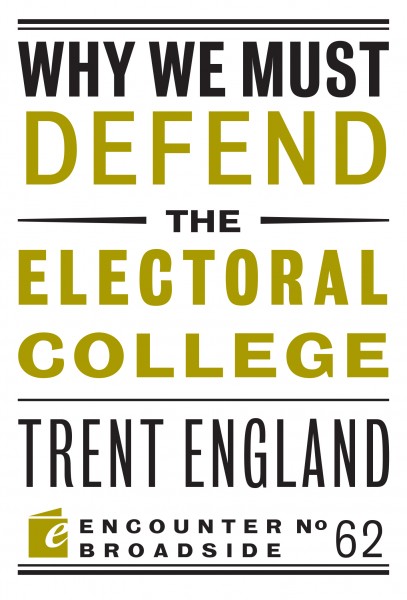
Trent England is the executive director of Save Our States and author of “Why We Must Defend the Electoral College” (Encounter Books, 2020).
