



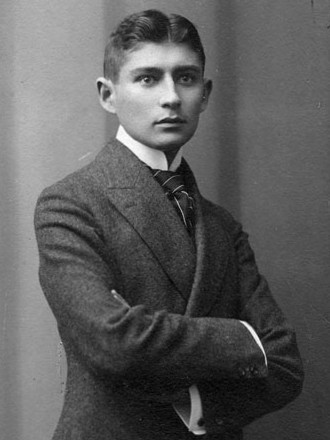
“There are some who say the word Odradek comes from the Slavic and they look for its etymology there. There are others who say it’s a Germanic word, merely inflected by the Slavic. The doubt surrounding both versions forces one to conclude that neither is true, especially as neither is any help in finding a meaning for the word.” So begins Michael Hofmann’s translation of “The Worries of a Head of Household,” one of Kafka’s more enigmatic short stories. Odradek is a piece of household refuse that refuses to disappear. It’s a jumble of bits of wood connected at right angles; it carries old strands of tangled thread; it lurks, seemingly moving of its own accord, and even responds to simple questions. Just as neither German nor Czech gets at the essence of Odradek, a broken-down remnant with “no fixed address,” Kafka himself, born into an upwardly mobile petit bourgeois Jewish family in Prague in 1883, lay, or rather stumbled, between those two nations. Kafka writes in his famous “Letter to His Father” that Kafka père retained only an “insignificant scrap” of Judaism, and while the author’s writing almost never invokes Jewishness by name, Odradek, a “star-shaped reel of thread” that survives from generation to generation, seems to be the sort of distinctly Jewish thing that lurks behind Kafka’s work and life.
Read Full Article »Something Is Missing
Comment
Show comments
Hide Comments
