



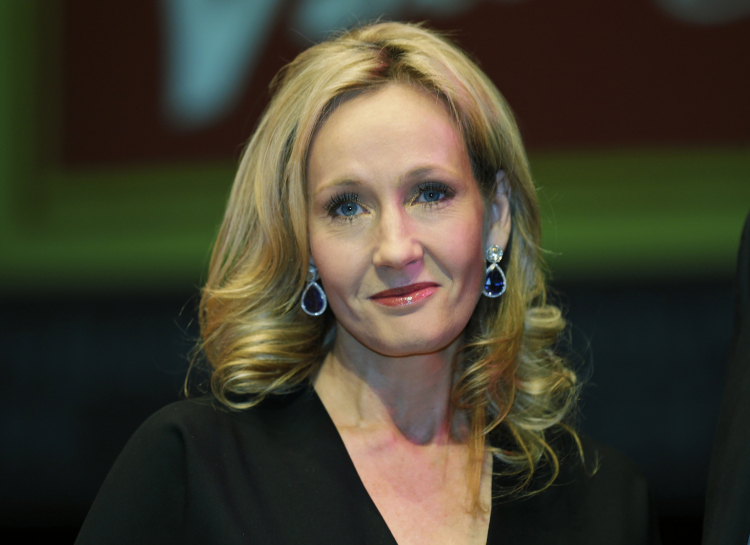
J.K. Rowling is arguably the most successful author in the history of publishing, with the possible exception of God. And “Harry Potter” was a kind of bible for my generation. Since its publication beginning in the late ’90s, the series has taught tens of millions of children about virtues like loyalty, courage, and love—about the inclusion of outsiders and the celebration of difference. The books illustrated the idea of moral complexity, how a person who may at first appear sinister can turn out to be a hero after all.
The author herself became part of the legend, too. A broke, abused, and depressed single mother—writing in longhand at cafes across Edinburgh while her baby girl slept in a stroller beside her—she had spun a tale that begat a global phenomenon. If “Harry Potter” was a bible, then Rowling became a kind of saint.
When she gave the Harvard commencement address in 2008, she was introduced as a social, moral, and political inspiration. Her speech that day was partly about imagination: “the power that enables us to empathize with humans whose experiences we have never shared.”
“We do not need magic to transform our world,” Rowling told the rapt audience. “We carry all the power we need inside ourselves already.”
The uproarious applause that greeted her in 2008 is hard to imagine today. It’s hard to imagine Harvard—let alone any prestigious American university—welcoming Rowling. Indeed, I’m not sure she’d be allowed to give a reading at many local libraries.
Read Full Article »