



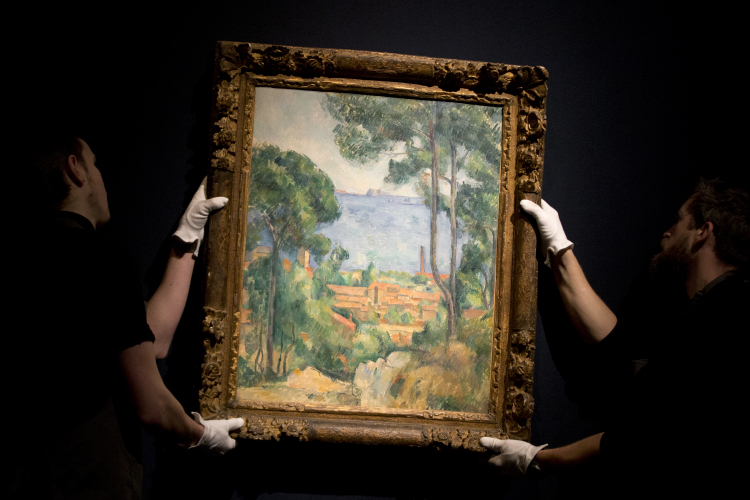
The pigments in paintings of Cezanne’s middle age cluster like gangs in a schoolyard. Cobalt, ultramarine and Prussian blue cleave to a bay or bolt of fabric. Emerald and viridian occupy pears, jars and foliage. The biggest grouping, the ochres and terracottas, huddle around roofs or rocks or bathers, while fiercer heats – oranges, lemons, apple reds – tear away from them, reaching for their respective fruits. How to make these fractious parties rub along is half the painter’s puzzle – in Curtain, Pitcher and a Fruit Bowl, a canvas from around 1894, a cushioning grey surface seems to aid his supervision. Nonetheless, the overall uproar is joyful. ‘He had no conception of beauty,’ Emile Bernard pronounced soon after Cezanne’s death. ‘He possessed only the idea of truth.’ This assessment, prompted by a letter in which Cezanne undertook to provide the young Bernard with ‘the truth in painting’, has lent generations of interpreters their cue. But fall in with the crowds visiting Cezanne, Tate Modern’s career-survey exhibition (revisionist in dropping the acute accent Cezanne acquired but never himself used), and the pace is frisky, not veridically grave. The zinging saturations, zooming this way and that, stir viewers. Whether or not they constitute beauty, they signal intensity – those hot, iron-rich pigments most of all. They attach themselves to desirables: to good fruit, to the good land of Provence, viewed under prevailingly fair skies.
We wander the galleries high-humouredly, yet often enough pulling a face. Cezanne’s private puzzling – just how should masses of lemon and lead white converse? – slips into provocative teasing. No, that plate on the right could hardly have perched in that way on a three-dimensional kitchen table, and yes, the fruit on it perform a balancing act that seems outright miraculous. But painters have always reserved the right to collage their observations, and Cezanne did so with particular vehemence. Let the shapes on the canvas spring away from one another with a tensile inner force: that remained Cezanne’s instinct throughout his career, from the figure-dominated work of his youth until his final collapse, aged 67, while working en plein air in 1906. Accustomed from childhood to baroque altarpieces and statuary, and finding that vein of taste commended by the mighty Delacroix, Cezanne always took it as read that his own work would obey expressive rhythms.
Read Full Article »