


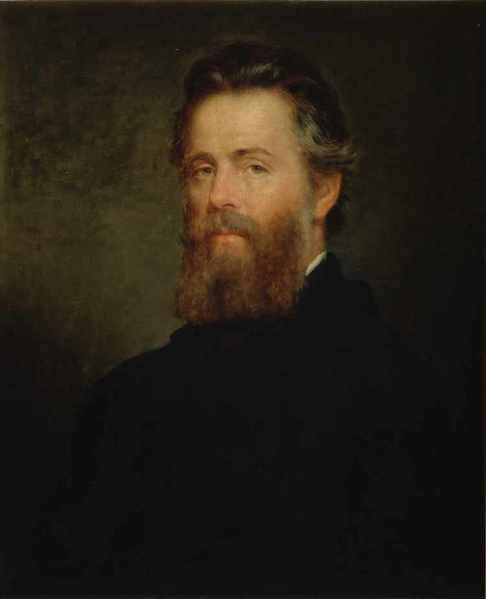
Herman Melville seems to have got the idea to write a novel about a mad hunt for a fearsome whale during an ocean voyage, but he wrote most of “Moby-Dick” on land, in a valley, on a farm, in a house a-dither with his wife, his sisters, and his mother, a family man's Walden. He named the farm Arrowhead, after the relics he dug up with his plow, and he wrote in a second-floor room that looked out on mountains in the distance and, nearer by, on fields of pumpkins and corn, crops he sowed to feed his animals, “my friends the horse & cow.” In the barn, he liked to watch them eat, especially the cow; he loved the way she moved her jaws. “She does it so mildly & with such a sanctity,” he wrote, the year he kept on his desk a copy of Thomas Beale's “Natural History of the Sperm Whale.” On the door of his writing room, he installed a lock. By the hearth, he kept a harpoon; he used it as a poker.
There is no knowing Herman Melville. This summer marks the two-hundredth anniversary of his birth and the hundredth anniversary of his revival. Born in 1819, he died in 1891, forgotten, only to be rediscovered around the centennial of his birth, in 1919. Since then, his fame has known no bounds, his reputation no rest, his life no privacy. His papers have been published, the notes he made in his books digitized, a log of his every day compiled, each movement traced, all utterances analyzed, every dog-eared page scanned and uploaded, like so much hay tossed up to a loft. And yet, as Andrew Delbanco wrote in a canny biography, “Melville: His World and Work” (2005), “the quest for the private Melville has usually led to a dead end.”
Read Full Article »