


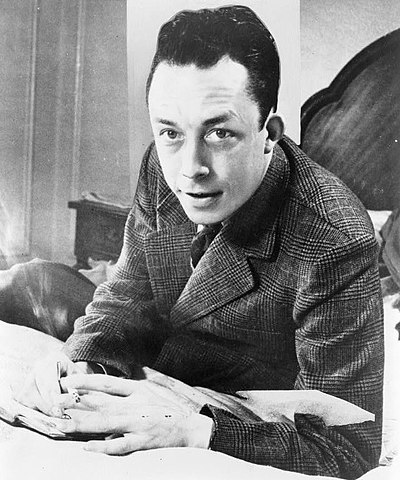
In 29 April 1955, Albert Camus gave a lecture “On the Future of Tragedy” at the French Institute in Athens. Tragedy for Camus, as for most people, was associated particularly with the drama. He seems not to have considered the possibility of tragic fiction, although of course there are numerous tragic episodes in his fiction. By the time Camus gave this lecture he had 20 years of reflecting on the subject behind him, as well as considerable experience as a dramatist, actor, and man of the theater generally. All his original plays were already completed and only two adaptations were yet to come—although they were both significant works, Requiem pour une nonne from Faulkner's novel in 1957, and Les Possédés from Dostoyevsky's in 1959. My suggestion in this essay is that Camus's sense of tragic drama, and the tragic generally, was significantly influenced by his lifelong quest for a viable form of humanism.
Camus's historical survey of the development of tragedy, in his Athens lecture, is conditioned by his opening question: is modern tragedy a possibility in 1955? He observes that the two great periods of tragic drama in Western Europe, those of ancient Greece and Renaissance Europe, came at key turning points in history. These were epochs in which rationalism and the cult of the individual were in conflict with a view of Man and the universe as bound together by the divine. Psychology replaced religion as the major explanatory principle of human action. Human beings were dissatisfied with the old worldview but had yet to find a workable replacement. Such, Camus says, is the situation in 1955, but can tragic expression be given to this “internal division”? (III.1119—all references are to the four-volume Pléiade edition of Camus's works (2006–08), and all translations are my own.) Artaud's concept of “theater of cruelty” had been formulated in 1938, and Camus's first play, Caligula (original version 1944, revised 1958), conforms to many of its prescriptions, although we can't be sure Camus knew Artaud's work at that point. Caligula (the character) was described by Camus in an interview in 1945 as committing “the most human and the most tragic of mistakes”; the play is “a tragedy of the intellect” because the emperor fails to realize that he can't deny the right of others to live without thereby granting them the right to destroy him in turn (I.447).
Read Full Article »