


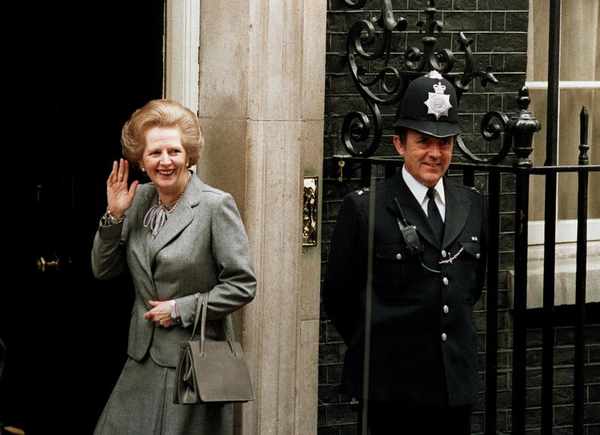
Forty years on, Margaret Thatcher's election as Great Britain's first female prime minister still looks miraculous. The rise of a woman to dominance, in the hostile, closed environment of the British Conservative Party, was astounding. In The Iron Lady (2011), Meryl Streep makes the point eloquently. But the miracle that followed Thatcher's election is no less remarkable.
Right after World War II, Labour prime minister Clement Attlee, overly optimistic about the capacity of government to do great things, laid the foundations of the British welfare state. The sentiment was understandable: centralized authority had just proved itself capable of organizing the country's resources in the war effort. Well-meaning do-gooders now assumed that the state could do the same postwar, defeating the peacetime adversaries of poverty and need. Filmmaker Ken Loach calls this attitude “the spirit of '45.” The postwar economic consensus was so robust that it became known as Butskellism, since the policies of Rab Butler, the Conservative chancellor of the Exchequer from 1951 to 1955, and his Labour predecessor Hugh Gaitskell were indistinguishable.
The glory days of interventionism didn't last, however. By 1979, a third of the British workforce was employed by government, directly or indirectly, yet unemployment continued to rise throughout the 1970s. Inflation rose to double digits, exceeding 25 percent, making even middle-class Britons insecure about their savings and purchasing power. Keeping it under control seemed impossible: government-owned businesses, unable to say “no” to the demands of the trade unions, administered a vast portion of the economy.
Thatcher recognized the economic crisis as a failure of politics. She offered a gospel of government retrenchment and individual initiative that sounded outdated. She wanted to make people responsible again for their economic destinies, instead of entrusting their fates to state guidance. This meant denationalizing the British economy. Before Thatcher took office, “privatization” was a word out of science fiction; ten years after she left office, it was a global norm. She changed England and, by changing England, changed the world.
Read Full Article »