


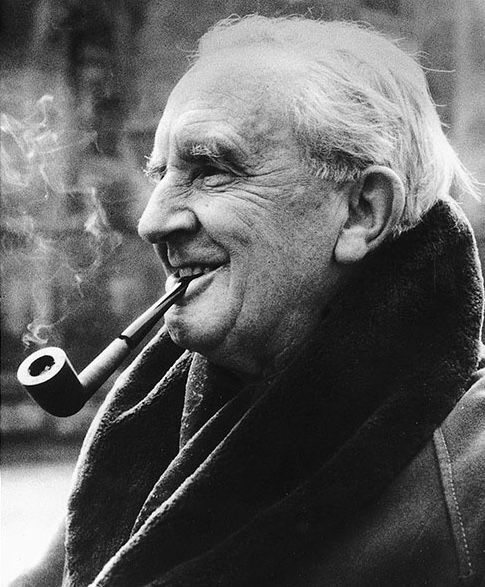
Alas, poor Tolkien the movie. The adjective “tepid” most accurately describes the critical response to this biopic, reverently directed by Dome Karukoski, which explores the early years of the author of The Hobbit (1937), the Lord of the Rings trilogy (1954–1955), and countless other works of medievalist fantasy. The idea behind Tolkien is that nearly every key theme in these novels had its origins in some episode of the young John Ronald Reuel Tolkien's life, first at the prestigious King Edward's boys' school in Birmingham (where, as the gifted son of a cultivated but impoverished widow, he had a scholarship), then at Oxford University (another scholarship), and above all, in the trenches of the Somme, where he was posted as a second lieutenant in 1916 and had ample opportunity to experience all the horrors of World War I before succumbing to trench fever carried by the lice that infested the cramped and filthy bunkers.
Thus, Tolkien, presented as a series of flashbacks playing inside the brain of the fever-stricken junior officer, trades heavily in one-on-one correspondence. Green and lovely Sarehole, the village in Worcestershire where Tolkien spent his early childhood, was, of course, the Shire. Extreme poverty after his father's death in 1896 forced the family to move to smoke-blackened Birmingham—yes, Mordor. As a student at King Edward's, young Tolkien (Nicholas Hoult), a prodigy already displaying a phenomenal gift for languages real and invented, bonds with three other high-spirited, arty youths (quartet of hobbits, anyone?), all of whom patriotically enlist when war breaks out. The Somme trenches, where two of those three are killed by German fire, are more Mordor. Stumbling through no man's land on a quest (hmmm) for former schoolmate Geoffrey (Anthony Boyle), the delirious Tolkien experiences an early twentieth century Mount Doom: orcs and Ringwraiths in the form of gas-masked Hun, a fire-breathing dragon in a swirl of gunsmoke. All that's missing is the Eye of Sauron. And yes, Tolkien has an adjutant named…Sam. When, toward the movie's end, a thirty-something Tolkien, now a professor of Anglo-Saxon at his beloved Oxford, announces out of the blue to his children that he intends to write a book about a “fellowship,” I started to laugh. Or, as dismayed Rolling Stone critic Peter Travers put it, “Oh, brother.” The real-life Tolkien, who loathed trite allegory, would have cringed.
Travers is scarcely the only critic to have decried screenwriters David Gleeson and Stephen Beresford's effort to turn the young Tolkien into a human-size Frodo. The Tolkien estate refused to have anything to do with this project. Several critics have noted that Tolkien omits all reference to Tolkien's Catholic faith, so intense and meaningful to him even as a young man that he persuaded his wife-to-be, Edith (a very elven Lily Collins in the movie), to convert—reluctantly—to Catholicism before the two married. Catholicism in Tolkien consists solely of Tolkien's officious if well-meaning legal guardian, Father Francis (Colm Meaney), a meddlesome priest who orders Tolkien to break up with the distracting Edith, at least until he reaches maturity. But the absence of any role in this film for Tolkien's religiosity is more a symptom than a cause.
Read Full Article »