


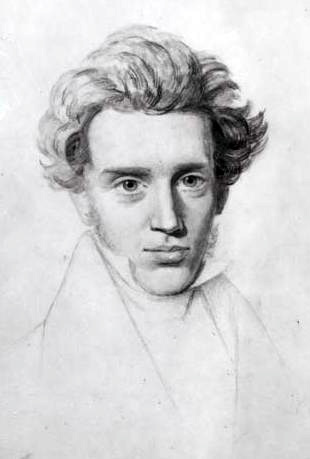
Soren Kierkegaard ought to be the patron saint of geeks. He must have cut a comical, even grotesque figure, in his frock coat and stovepipe hat: the eternal flâneur, promenading around Copenhagen on his spindly legs, with a slight limp due to curvature of the spine, peering through thick spectacles, hoping to glimpse his former fiancée Regine Olsen, the eternally unattainable beloved. After he broke off their engagement, she returned his ring and he had its diamonds reset to symbolise the cross whose crushing weight he bore.
Just as Kafka's nightmares still haunt Prague, so Kierkegaard is the soul in torment whose remains lie in Copenhagen but whose pseudonymous spirit has never been laid to rest. He is the philosopher of angst and dread: our inconsolable Doppelgänger, the conscience-stricken companion of modern consciousness, who, like Hamlet's father's ghost on the battlements of Elsinore, implores us: “List, list, O list!”
We live in an age of introspection. For old guides for the perplexed, this means a new lease of life. But if the majority of these gurus are male, their readers and interpretersare increasingly likely to be female — and this gives rise to a different hermeneutic perspective. Clare Carlisle's Philosopher of the Heart: The Restless Life of Søren Kierkegaard is one of the best biographies of modern masters by a new generation of women scholars. Another outstanding example, which appeared a few months ago, is Sue Prideaux's I am Dynamite: A Life of Friedrich Nietzsche(Faber, £25). She has already written lives of Strindberg and Munch.
What is refreshing about these female critics is their ability to empathise with solitary, depressive, even suicidal men such as Kierkegaard and Nietzsche, while avoiding the trap of making them larger than life. Male biographers of these pioneers often succumb to the temptation to turn their subjects into heroic, if tragic, supermen; but one only has to peer fleetingly into their tortured lives to realise that the quotidian reality must have been very different. Myopia and misogyny, hypochondria and hypersensitivity, neuralgia and neurosis: both were borderline sociopaths, preachers and conversationalists of genius but almost insufferable as colleagues, friends or lovers. Both used writing as therapy to relieve their loneliness and suffering, but also to sublimate their frustrations and aggressions. To modern eyes there is something irresistibly comical about these intellectual Übermenschen, right down to their eccentric hairstyles: Kierkegaard with his six-inch-high quiff, Nietzsche with his trademark tea-strainer moustache.
Yet these men turned their physical frailty into something positive, even dynamic, which the women who knew them well were the first to appreciate. Lou Andreas-Salomé — the young woman to whom Nietzsche proposed, whom he designated as his beloved disciple, and who later became one of Freud's — diagnosed him thus: “He is the cause of his own self-induced illness.”
Bizarrely, these two modern monks identified with Don Giovanni. Kierkegaard rarely missed a performance of Mozart's opera, and perhaps his best-known work remains the “Seducer's Diary” section of Either/Or, which made the book a succès de scandale. As for Nietzsche, he saw the Don as a fearless seeker of forbidden knowledge, ready to risk eternal damnation for the sake of proclaiming the terrible truth about existence.
Yet intelligence is an aphrodisiac: despite their unprepossessing appearance, both Kierkegaard and Nietzsche displayed such intellectual confidence that plenty of clever, self-educated female contemporaries were drawn to them. Carlisle depicts the young Søren entrancing both girls and older ladies; they flocked to his funeral.
Perhaps the best friend Nietzsche ever had was Malwida von Meysenbug, an aristocratic revolutionary who was also an acolyte of Garibaldi and tutor to the daughters of Alexander Herzen. Prideaux points out that “all his life [Nietzsche] valued intelligent women, making close and enduring friendships with them.” Even his deeply sinister sister Elisabeth — the literary executor from hell, whose machinations sabotaged his posthumous reputation — began, Prideaux reminds us, as an intelligent girl. She alienated her devoted brother by adopting the role of a shallow, snobbish anti-Semite, later to exploit his helpless, psychotic husk.
Yet Nietzsche was also capable of the notorious passage in Also Sprach Zarathustra: “You go to women? Do not forget the whip.” This crass remark (uttered by “an old woman”) has become associated with a photograph of Lou brandishing a whip over Nietzsche and his friend Paul Rée (who was also in love with her). Long afterwards people asked her if she and Nietzsche had ever kissed. “I no longer remember,” she would reply. Lou had many lovers in her long life; Nietzsche perhaps none, apart from a couple of prostitutes from whom he contracted gonorrhoea (not syphilis, as diagnosed by his doctors and fictionalised by Thomas Mann).
Read Full Article »
