


IN SEPTEMBER OF 2017, Hurricane Maria made a deep wound in the United States. Millions of Americans in Puerto Rico suffered. They lost schools, jobs, homes, and lives—well more than 4,000, according to a study months after the event. But when President Trump arrived on the island on October 3, he wasn't mourning. He was goofing around. At a relief center outside San Juan, he pantomimed a basketball player shooting free throws. He cradled roll after roll of paper towels in his left hand and, with the finger-tips of his right, launched them into the photo-op crowd.
That the president went for antics in a moment of anguish was in character. But American mainlanders' lethal disregard for Puerto Rico is a historical constant. When Franklin Roosevelt said that “the only solution” to the colony's poverty was “to use the methods which Hitler used effectively”—by which he meant forced sterilization—he was revealing a blunt racism that is shocking even by Trump's standards.
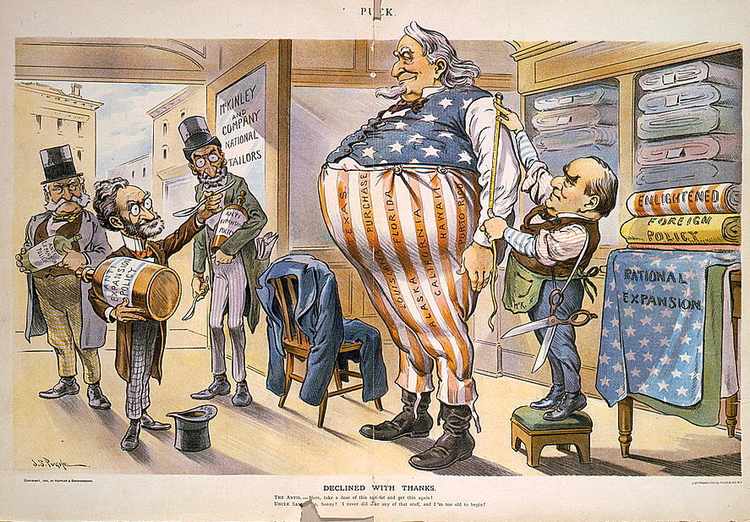
In How to Hide an Empire: A History of the Greater United States, Daniel Immerwahr explains how mainlanders forgot to care about Puerto Rico and the other not-quite states our country has controlled since its earliest days. The book is not about any particular person, place, or event. It's about how people think and don't think. Immerwahr directs attention to the forces that have made us oblivious, preventing a moral accounting with empire and its animating racism.
This obliviousness is acutely strange. The other imperial powers of the nineteenth and twentieth centuries not only thought hard about their possessions, they also rejoiced in them. Brits and Frenchmen, Belgians and Japanese celebrated empire with holidays, anthems, parades. And why not? Empire provided economic prosperity and affirmed national superiority. Of all the major colonizers, only Americans averted their eyes.
Immerwahr wants us to look, and his highlight reel of U.S. empire is worth watching. His main concern is not the metaphorical empire of United Fruit and kimchi Big Macs but empire in crystalline form: spaces beyond borders, which the United States bought, conquered, annexed, and ruled.
Today these spaces don't amount to much, geographically: Puerto Rico, Guam, a collection of other small islands, and about eight hundred known military bases scattered across the globe, which are critical to U.S. power but encompass scant terrain. Historically matters looked different. In 1791 only 55 percent of U.S. land was bounded by states. The rest was federally administered territory about which the Constitution says virtually nothing and over which Congress and the president had fiat authority.
Read Full Article »