


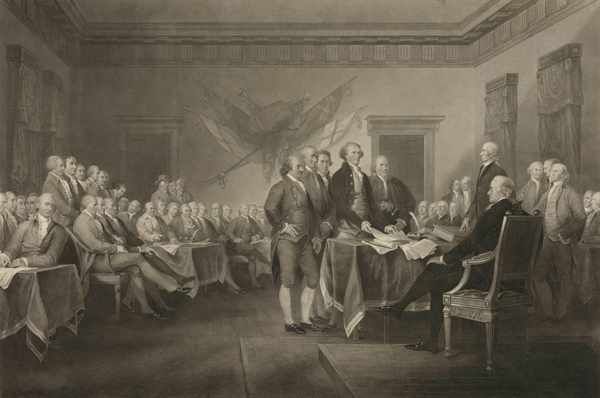
Real presidents read books. When the Library of Congress was destroyed in the War of 1812, the former president Thomas Jefferson offered his collection to replace it, commenting that “I do not know that it contains any branch of science which Congress would wish to exclude from this collection … there is in fact no subject to which a member of Congress may not have occasion to refer.” Congress agreed, purchasing the bulk of Jefferson's library, 6,487 books, for $23,950. That this interaction between Congress and a president—this cooperation based in a common love of knowledge—is completely unthinkable today should be a cause of deep and sustained sadness.
The story of Jefferson and the congressional library is a telling vignette in Jennifer Ratner-Rosenhagen's The Ideas That Made America, a quickly paced but surprisingly dense survey of thoughtful activity in the United States from the 1600s to the present. Her message is clear: American history is, has always been, and one hopes will remain an intellectual history. Thoughts, the most abstract and intangible of entities, matter, she contends, and arguably have mattered more in this country than in any other. In advancing this position, Ratner-Rosenhagen's latest book is not unlike Carlin Romano's America the Philosophical or Louis Menand's The Metaphysical Club. This slender volume is no monument, but it provides a clear master narrative of the American past at a moment when people are feeling particularly whiplashed by instability, partisanship, and uncertainty. More important, the book offers a reader the opportunity to think through an array of distinctly American ideas, and thereby become the sort of intellectual who is prepared to remake a country.
“In the beginning was the word,” Ratner-Rosenhagen writes, “and the word was ‘America.' ” Before there was a nation, there were ideas, clear yet often contradictory, about what this country should become. Ratner-Rosenhagen explains that when the Puritans arrived in the New World, they imported a philosophically sophisticated and religiously inflected idea about belonging. In coming to America, they had chosen exile, which ensured their religious freedom but also jeopardized their claims to a cultural heritage. They risked losing, in historian Jill Lepore's words, their “Englishness.” To counteract this danger and to guard against pitching into savagery, they created a New England, which was to be an exceptional place, one that stood not only as a political exemplar but more crucially as a moral one.
“The Lord will be our God, and delight to dwell among us, as His own people,” John Winthrop proclaimed. “He shall make us a praise and glory that men shall say of succeeding plantations, ‘the Lord make it like that of New England.' For we must consider that we shall be as a city upon a hill. The eyes of all people are upon us.” There was, however, a flip side to this seemingly noble goal. In her opening chapter, Ratner-Rosenhagen deftly explains how the wedding of strict morality and exceptionalism had the natural, yet very ugly, offspring of xenophobia, exclusion, and oppression. Only certain types of people could live freely in America's city upon a hill. Only certain types of ideas got to matter. “We may speak of a ‘war of ideas,' which may have truth to it, but only as metaphor,” she writes. “In the case of Native American ideas during the first century of contact with Europeans, it was actual physical warfare—violent, bloody warfare—as well as disease and loss of land, that drove their ways of understanding to fade from historical memory.”
Read Full Article »