


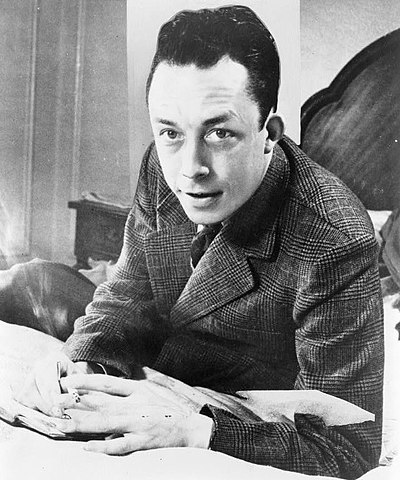
n 16 October 1957, Albert Camus was eating lunch at a restaurant in the heart of Paris's Latin Quarter. Partway through the meal, a young man from his publisher's office appeared. The young man dismissed the waiter, and informed Camus of what had just been announced on the radio: he was receiving the Nobel Prize in Literature.
One week later, Camus was interviewed on French television. However, the author and his interlocutor weren't sat in a comfy studio, discussing the power of the written word. They were sat in the Parc des Princes, among a crowd of 35,000, watching Racing Club de Paris host Monaco. The black-and-white footage is preserved on YouTube. Wrong-footed, the Racing keeper reacts slowly to a deflected cross, letting the ball bobble inside his near post. We cut to the stands, where Camus – looking more than ever like a softer-faced Humphrey Bogart – is asked about the keeper's blunder. He implores us not to be too hard on him.
As far as I'm aware, this is the only time that a fresh recipient of the Nobel Prize has been interviewed at a football match. (That this registers as incongruous, vaguely comical, is in part the topic of this essay.) Thanks almost entirely to a much-circulated misquote – “all that I know most surely about morality and obligations I owe to football” – Camus' fondness for the game is well-known. But this fondness was more than a passing wistfulness, or a single throwaway aphorism. In 1959, less than a year before he died, Camus told another interviewer that, along with the theatre, the football pitch had been one of his two “real universities”. In football, one of the greatest French authors of the 20th century located the most potent and valuable forms of consciousness. In the game's drama of the flesh, he felt himself witness to the fullness of life, in all its pathos, and all its saving graces.
Explaining its decision, the Nobel Committee declared that Camus' “clear-sighted earnestness illuminates the problems of the human conscience in our times”. This bland bit of PR distracts from the intensity and anguish of Camus' work. The central problem that he wrestled with was simple: life is absurd. Why? Because we are filled with a “longing for happiness and for reason”, but are met everywhere by “the unreasonable silence of the world”. Modernity has blasted away the old consolations of religion, revealing the universe to be a great, cold blank. Our souls yearn for transcendence, but, as Beckett writes in Waiting for Godot, we “give birth astride of a grave, the light gleams an instant, then it's night once more”. This basic mismatch, between our psychic craving and what reality provides, is what renders life absurd. Camus compared human existence to that of Sisyphus, who in Greek mythology was condemned by Zeus to roll a boulder up a hill, only to watch it roll back down, over and over, for eternity.
And so what to do? Suicide isn't an option. This would only compound the absurdity, and in any case Camus adored the experience of being alive; the tragedy was precisely that reality was so sumptuous, yet was forever slipping away “between my fingers, like beads of mercury”. But Camus couldn't accept the “philosophical suicide” of religion, either. Though he was fascinated by religious devotion – and, like so many people who spend their life drowning in words, occasionally told friends he intended to retreat to a monastery – it wasn't in him. His bouts of asceticism would always wane. Camus wanted to be in the world, to face it squarely without succumbing to either despair or delusion, both of which he regarded as forms of psychic surrender.
